jeudi 21 avril 2011

Spring in Sardinia

Spring in Sardinia. We arrived just on the cusp, and for the first few cool days we thought it had been a mistake. In Olbia we had a ground floor apartment in an old stone and stucco building in the narrow cobbled streets of the medieval center. In the morning, as the Mediterranean sun flooded the nearby port, our apartment was dark and cold. Outside the sweet air of dawn brought birdsong, while we huddled in darkness.

Across from us an older Sarde woman stayed inside her small dark house all day--we could clearly see her flat screen TV on from early morning, what they call the "cathodique religion." She was visited frequently by a small man on a bicycle, perhaps her son. When he left she came out on the narrow street to watch after him long after he had disappeared. Life was titrated in stingy doses through those close cobbled streets, whereas when we would move (halfway through our journey) to Cagliari, to a spacious beach condo of marble and slate, it would burst upon us with an almost unbearable intensity. But we began only at the cusp of it all.

People were taciturn but smiled easily. Walking at sunset along the bay the mountains were etched in crystal air even as a slight haze clung underneath soaring pink clouds that piled into heaven. History seemed to sit like a foreign presence. We heard little about personages, stories or memories. It felt as if those stories were in the villages themselves, in a language we don't understand, and in legendary vendettas and feuds that we could never understand. We saw timeless fields and sheep and newborn lambs frolicking, beautiful brown and white cattle on idyllic slopes.  We felt a remoteness of the land, its people and its secrets.

And then: Spring. Incessantly perfumed air, baby animals that had just been born, dewy tender grasses growing through the crevices in the Nuraghe--and the wildflowers. To my untrained eye, these are but a few of the flowers throwing their fragrances all about us:

Mostly brilliant yellow, in contrast to the indigo and turquoise sea, like the reverse of camouflage, but also: hydrangeas, red poppies, lavender poppies, cacti blossoms in crimson and yellow, succulent blossoms in neon magenta, mimosa, wisteria, blue blossoms of flowering rosemary, yellow blossoms of flowering fennel, tiny pink orchids, some of them striped, bristling stalks of pale star-shaped blooms, sometimes divinely fragrant, in other places smelling vaguely like dog pee; daisy-like marigolds, deep purple azaleas, fragrant red-violet blossoms in bushes of enormous geraniums, the tender heady yellow blossoms of wild freesia--everywhere, but it is called here the flower of Corsica; brilliant red violet jacarandas and similar blossoms on faux-plum trees, hollyhocks and sturdy zinnias of a violent orange; purple thistles and fragrant bushes of marguerites, and red-violet blossoming thyme. And apple blossoms, and the overwhelming fragrance of orange blossoms. I can only name part of what surrounded us. And I'm not even sure of their names.

Then there were the baby animals: mostly lambs, who really did frolic as if their legs propelled them in near somersaults; tawny handsome calves; piglets who ran toward our car while their huge mother backed off; beautiful young asses with markings like antelope.

We stopped by Costa Paradiso, which was once a hippy haven and is now a gated community with international real estate signs everywhere, only to see an immense wild boar and her little babies scamper up the steps of the climbing homes and disappear. They are very intelligent creatures.

A magnificent white horse who seemed like a unicorn--we spotted each other from afar. He galloped back and forth in his space, and fixed me with a direct gaze. I longed for him. We watched each other across a field. Then we drove off.

Puppies tumbled around their fierce mothers, and the stray cats who were not pregnant nursed kittens.

Then we left just as the religious festivities were to begin. Any Sard we spoke with, even our soft-spoken intellectual guides who seemed like scholars with a fierce pride for their island, were excited. They would take part, they would walk in a procession for four days from one church to the next, as mannequins were carried, dressed in finery none of these people would ever possess. It was, to them, being Sard.


But we came only at the cusp.

mercredi 20 avril 2011

Sassari, Immigrants and Artifacts

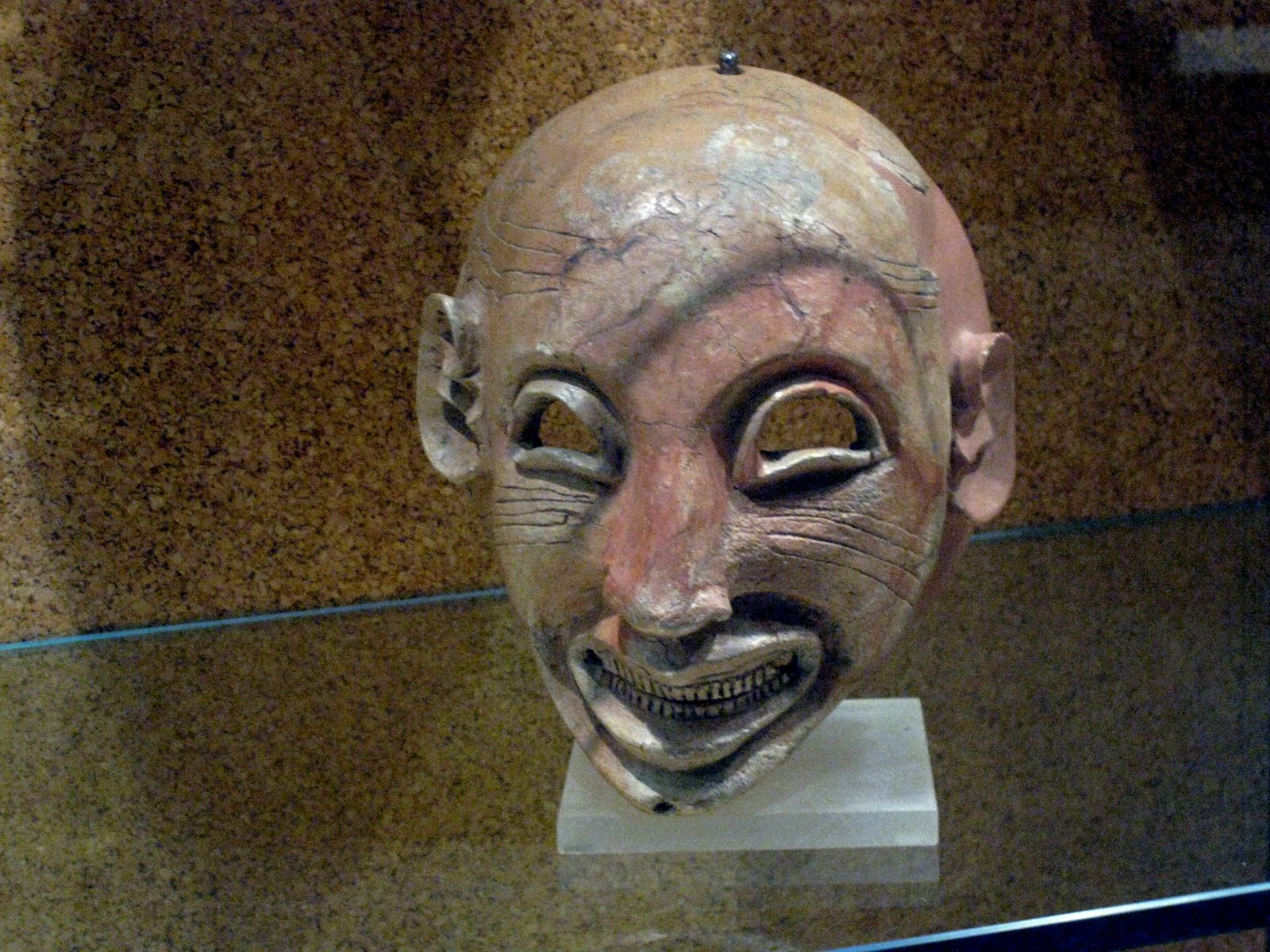
Some of the oldest and strangest things in the land of the Sards, aside from the 3,000-year old ruins lying by the side of the road or in fields of sheep or cattle, are in the archeological museums at Sassari and Cagliari. Those visits bookended our trip, helping us make some sense of the time-space continuum. Arrowheads and little proto-Venuses, from thousands of years BC, beautiful jewelry, and the elegant pottery of the Nuraghe, then the burial treasures that often came from Etruria or Egypt, Pheonician symbols like the Eye of Horus which is pure Egyptian, Carthaginian masks (I made a mask like this, once) and facinating beadwork, Roman statuary and mosaics--it's a long, long story. As mentioned in an earlier blog (Train to Sassari), our first day out we took a train across the northern interior to what had been the first free commune of Sardinia (1294), and remained rebellious and politically significant through the centuries of occupation. Sassari is the second largest city with 129,000 inhabitants.
Rosello Fountain, Genoan

The vista from the train station is disheartening, construction mixed in with the 13th c. wall of thick stones that now back up umbre and gold houses. We bolstered ourselves with espressos at a cheerfully glum cafe like those all over Europe. The first stop, at a 17th c. Genoese fountain, is magical, not for sculptural beauty, but for its bright white presence down a grassy slope where children played and sketched. It is the site of a spring divinity, a water source that has been used since the 13th c.

Gothic Catalan Palazzo
St. Nicholas Cathedral


Then we entered the streets, rough granite, whorled columns, and stodgy monuments of the gothico-catalon style, all mixed in with a grimey somewhat out-of-time city--not so much dirty as mired in a desolate quality, growing like a jungle around the remaining architecture of a medieval and Renassance past. We climbed up the honking Corso and then down narrow streets where centuries-old stone vaults grace the interiors of store fronts, and out to the splendour of the Duomo, the centra Cathedral of every Italian city. A fantasy of Spanish baroque, massive and fussy at once, its facade centers around a sour-faced St. Nicholas. Inside the main hero seemed to be a war-like young man on a horse. The piazza had charm and grace, bright yellow facades with clean baroque decor. Sidestreets were neat, like Sicily's Sicracusa, while the Corso was like Sicily's Catania, dark gloomy stone. Over the spacious main square stands Victor Immanuel, united Sardinia's first ruler, square and pig-like, facing a huge neo-gothic bank that looks Venetian.

Model of a Nuraghe, Sassari Museum
There were streets that radiating from the square that felt like the Cote d'Azur, weather beaten warm facades with green or brown shutters. Only one architectural fantasy stood out, bubbling with victorian-looking sprites and bright-eyed nymphs.

As we rested on a piazza a Senegalese woman approached, tall and elegant and open-faced, with long corn-row braids and her wares. The Senegalese are everywhere in Italy, with their baskets of batteries and socks and charcoal lighters, or crafts from Africa, or in her case leather purses. In Venice they carry big plastic bags of designer-bag knock-offs, as they do in Florence. When she approached us I said to her, "Lui, il est né a Dakar." Telling people that Jacques was born in Senegal is always a good conversation starter.

Greek Erotic Vase, found in Sassari
"Dove?" she kept demanding. Where? Where was he born? What hospital? What street did he live on? She wanted to have his every memory of his birthplace, where he had lived only briefly while his father worked as an engineer installing railroads for France. The history between France and Africa has not been pretty, and Jacques had spent his career apparently trying to compensate for it, as a development economist for the poorest countries in Africa. We quizzed her---how did she come? Her husband had brought her, he had a job in a restaurant. He was bringing her sisters. He must have had papers, she was lucky. No matter how homesick she seemed to be.

Bronzetti, ~1000 BC

"These poor Africans," Jacques would say as more and more Senegalese appeared whenever our car stopped at a traffic light, or as we walked down the streets or sat in a café. "Everyone's screwing them." Sometimes they seemed stolid and dignified even peddling their trinkets, sometimes mischievous and smiling. "They're not shy, Senegalese," said Jacques. In Cagliari a big man dressed in an exotic combination of a Muslim-style culotte and straw hat seemed to be a leader of a group of Senegalese chatting on the street. We trailed two of them in Nuoro, wearing jogging suits, talking about soccer in a combination of Woloff and French. "Actually, soccer's their favorite thing," said Jacques. "They must feel at home here." Most places teenagers would lounge in groups in sunglasses and languid poses of discontent. Their deep black velvety skin stood out everywhere. "They're living 10 to a room, sending every centime home to their families," said Jacques. Looking directly at them often caused them to disappear in the crowd. And at about this time the Italian news, wherever we happened on a TV in a restaurant, was of Berlusconi and Sarkozy teaming up in an anti-immigration initiative, shipping back stowaways who had landed, like most, on Lampedusa. While, unbeknownst to us, our femme de menage back in Paris, Albertine, was mourning her nephew, suspected murdered in a retalitatory killing in the growing civil unrest of her homeland, the Ivory Coast. It turned out, luckily, that he was released alive after the desperate pleading of his sister.

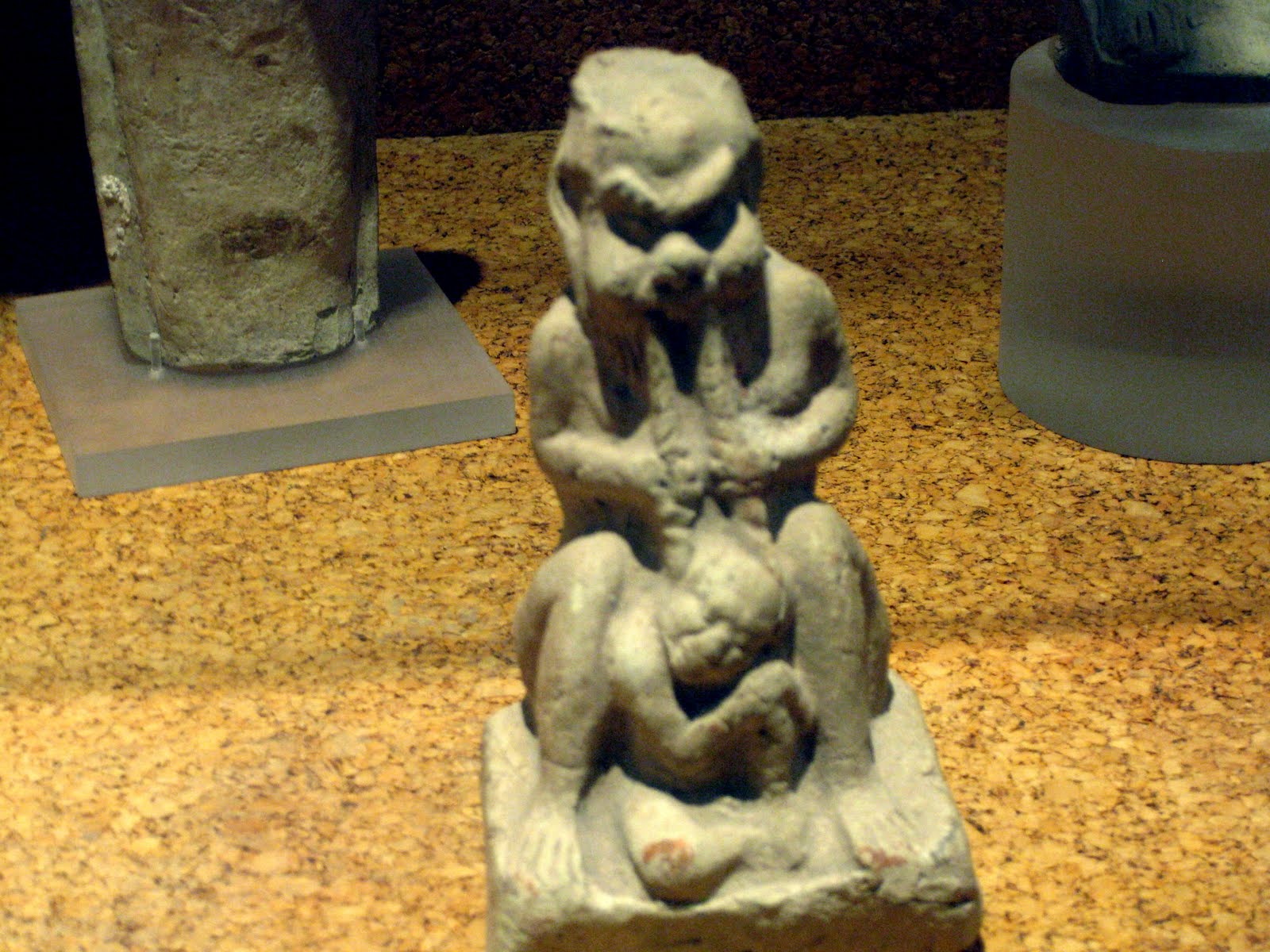
Local versions of Bez, fertility god of Egypt
And so, even as I clucked and cooed each time I saw a farm animal or a stray cat or dog, Jacques retaliated by clucking in babytalk every time he saw a Senegalese.

But we had come to Sassari for the museum, where Sardinia's history resides. It welcomes you with a modest charm, scattered boulders and a rustic garden. The artifacts begin at about 3,000 BC, the labeling system meticulous but obscure. And thus far, it was all new to us.

Carthaginian mask, ~300 BC
Bez
That was our first encounter with the strange, defensive mounds of the Nuragic age (1500-800 BC) and the jewelry and weapons found in ancient burial mounds and in the later Phoenician and Carthaginian graves. The old fertility goddesses, looking a little Humpty-Dumpty-ish, or the powerful Tanit goddess, who began as nothing but a triangle with arms, and Sardinia's own Babai, a father of fertility. Then there were gods from around the known world, Bez, the misshapen fertility god with the erect phallus from Egypt, tiny statues that had been buried with ancient Sardinians, of deities and animals, and friezes found at tophets, the gravesites of infants. Following these the more skilled while rather unfeeling Roman sculptures--Venus, Demeter, Mercury--and some unbeautiful mosaics. It was exhausting and bewildering, and we went out into the emerging sun, and the marvelous train ride back to Olbia.


mardi 19 avril 2011

The Costa Smeralda

The Olbia Airport was undoubtedly created for jet-set tourism. The airport's pizza stand is outdoors with luxury wicker chairs under the wide sky, where fragrances began to assail us, the wild freesia and the prickly maquis, tart and heady smells. The smoking lounge is also a courtyard under the sun, with luxury wicker furniture that does not blame you at all for smoking. That jet-set's destination is the Costa Smeralda, the northeast of Sardinia whose sublime shades of blue and green, sea and sky, are knit together with gargantuan tawny and red rocks, sculpted by wind and time into extraordinary creatures. The bristly maquis and the overflowing abundance of wildflowers fill the air. The roads are not punishing, especially when we arrived, which was quite off-season.

Costa Smeralda was not our first glimpse of Sardinia, but it was pretty much our second glimpse. Even before picking up our rental car, which absorbed almost a full day of research till we found an incredible price, about 16 euros a day, we took a heavenly, winding bus ride to Palau under gloomy skies to a gleaming white ferry, clean and Greek, where we feasted on salted peanuts at the bar and stood in the challenging cold to watch immaculate islands sail by. The most beautiful was Caprera, where Garibaldi died, but which we skipped even though it is a lush wildlife preserve. Others include St. Stephano, where the US had a submarine base. Our destination was La Maddalena, pristine and somewhat open for business.

Ile of Caprera
La Maddalena climbs in umbre increments up a green hill that rises to a soaring indigo sky, touching the brilliant turquoise sea. The immaculate harbor front of 19th c. Italian noble houses now covered with ads for tourism businesses, still has its bedraggled drunk or two. The harbor on one side blows with a stiff wind, on the other basks under a flattening sun. Steps and stone streets climb up to a featureless neo-Baroque church, which was closed, and past genteel colorful houses where Italian teenagers dressed like punks ride motos. It is an immaculate village in perfect gold and rose facades, with legant baroque details and the usual discount shops of "Cina" (China). An esplanade of palms runs along the harbor of clean, rocking white masts.

We walked back and forth where all was too orderly to be interesting, and had seafood salads sheltered from the wind but under a merciless sun. Back in the soaring ferry into the rough wind, but now the sea was pure turquoise and the rising rock islands pink and gold and a velvety forest curved along the shore. Matisse's Mediterranean. We walked along the harbor and small white beach of Palau, with its perfect clumps of reeds and groves of trees that appeared like velvety green heads of hair from a distance, like a Maurice Sendak drawing. The woods whistled in eerie stillness surrounded by the strong wind, like the sound of death. White billowing clouds pierced by blue cloud plateaus, pure white boats and ochre houses climbing the hills. Then we sat in the full sun of the harbor till the bus wound back among the heights of surreal rock formations and deep green brush of the legendary Costa Smeralda.

Two days later we got our rental car back at the airport from two sharp Italian boys who, bright-eyed and bushy-tailed, had already set up their baksheesh by leaving us a scratched car without recording the scratches, and disappearing before we could talk to them about it. (We emailed the company and had no problems when we returned the car, 3 weeks later.) Free at last we stopped at a EuroSpin discount market where I consulted a matron with huge hair about the size of the underpants on sale. And then we took off, winding along the coast where spectres of granite rose in hazy blues from the sea, and the wildflowers blew their fragrance into the car.

Though much of the luxury tourism was still not open, there were more modest restaurants with the same white beaches and breathtaking sea colors (Mama Beach, Mama Pizza). We got out on an overlook. Down a path was a strange little shack - Attenti di Cano, the sign said. A little dog came out and looked at us welcomingly, but Jacquess insisted he would be okay without us so we left along winding lost roads to immaculate white srony beaches in a a cool wind overlooking the sea 's gradients of turquoise. We walked on crumbling, glittering mica and whitest rock to the transparent waters lapping at the beach.

Golfo Arancia is a forbiddingly banal development at the exquisite bay at Capo di Figaro, but drive further along the old brown railroad tracks where an old white dog bellows, past colorful little blocks of fisherman's houses, along a dirt road where brilliant yellows and golds grow and there is an enormous ferry to Corsica and timeless blue rock islands humping all along the sea's horizon.

We drive on to Porto Rotondo, where the jet-set keep houses crowded in a sort of cluttered adult summer camp for the rich and famous, including Berlusconi. Everything is made of the red tan rock giving a feeling of clunky density that distracts from the beautiful landscaping of olive or poplar trees, now in their hairnets. We take stone walled path to the white beach.

There is a small harbor of enomous boats, (but only squat toilets). The overall impression, notwithstanding the setting's clientele of rich and famous people who come here to be seen, was not that different from Walnut Creek or any number of attractive California shopping malls.

But driving along Costa Smeralda among scrub and maquis is amazing. Olive trees twist over velvet green trimmed by herds of sheep, or cows, tan and golden, matching the contorted rocks that bear the curves of wind-sculptures or rise in pink glow under a shaft of sun. The luxury developments with their Italian tiled roofs are surrounded by ribbons of dusty road, soft and golden as the bubbling rocks., and among ruins of ancient roofless stone houses and a huge rustic crucifix.

Flowering blue rosemary, butter white blossoms and explosions of yellow and gold, the freesia pouring its scent into the moving car, bristling maquis and enormous dandelion bushes, thick enough to hide fugitives as happens in the center of Saridinia, but not here. We are driving on the Costa Smeralda.

Porto Cervo, more dignified than the nouveau riche flavor of Porto Rotondo, has an old port owned by the Agha Khan who has protected the region's wildness for luxury tourism. Here the deep green and warm brown rocks support a kind of Andalusian architecture, more refined than Porto Rotondo. Here you have another mall of adobe, stuffed with luxury shops, but only serving staff can be seen, preparing for the glamorous ones to come and be seen. And, like Porto Rotondo, the public toilets are the squatting kind.

Where the Agha Khan fell in love with the coast
The Agha Khan discovered the coast as a 22-year old student who fell in love with a beach that we visited, Poltu di li Cogghji (that's not Italian, but the Sard language). It is still remote, difficult to find, a hike away from the unmarked road where only hotels have signs, and completely undeveloped. We only saw an elderly couple having a picnic, and some rough Sards fishing.
Stella Maris
The church of Porto Cervo is interesting and beautiful. Called Stella Maris, it is of a neo-mediterranean architecture that looks like an adobe church from New Mexico on hallucinogens, of a stark brilliant white, with a kind of Andalusian appearance. Inside the decor was simple, of the sea, except for a dolorous Madonna by El Greco, with large blue eyes. As we left the church, a crowd of German tourists inside, we heard choral music swelling its white curving walls.

Poltu di li Colgghji
Notwithstanding our guidbook's hyperventilation about the beaches of the coast, we skipped most of them, to proceed to an older and stranger land of the Sards.

lundi 18 avril 2011

The Romanesque Churches of Sardinia

Sardinia is one of the oldest lands in Europe--there are traces of people from the Paleolithic period, 500,000 years ago, and a major civilization has left many traces from the 2nd and 3rd millennium before Christ. Located between Europe and Africa, Sardinia has known many invaders and oppressors, and remained at its core proud and unique. One of the proudest epochs was that of the Giudicata, when the Romanesque churches were built. Before that Rome had occupied Sardinia till her own fall, in the 3-5th centuries AD, leaving the island prey to Vandals and Arab forays. Justinian, emperor of Byzantium sent protection, and thence began the period of Byzantine influence, which developed into a system of autonomy for the four regions of Sardinia as they still exist. They were called Giudicata, and reigned from approximately 1000-1300 AD.  They organized ecclesiastical systems along with their political, erecting monumental Romanesque churches.
Inside Nostre Signore di Castro

We drove to the Luogodoro to see some of the lone monuments to that era. Nostre Signore di Castro, set high on the sloping green pastures, is a miniature Romanesque, with its own cloister, a small but shapely church with a simple interior, from the 12th c. A sort of Quasimodo keeps the grounds there, with his many cats and the occasional stray dog. A sweet-faced white retriever greeted us, limping though it was still young. Below us, the lands of the region spread below the still regal basilica.

Bisarccio
The Basilica Santissima di Bisarccio, a grand bastion of Romanesque, was built in the 11th c. out of the region's stunning red trachyte stone that felt such a relief after the gray granite of the Gallura region. Out of nowhere a small young white female doggie burst into our arms, crawled into our car, and had trouble leaving. Ah, the dogs of the fields, many of whom herd the sheep, but perhaps others simply roam. The young bureaucrat at the adjoining tourist office told us it was closed on Mondays. When we returned the next day, he had already closed shop.

detail of Bisarccio
Nostre Signora del Regno is now surrounded by the village of Ardara. A shapely Romanesque of a darker, more forbidding stone, it contains inside, beyond our sight, a magnificent retable (altar painting), the largest in Europe. But the village was quiet, the priest nowhere to be seen, and the house next door ignored us stubbornly.

Then we stumbled upon San Michele (we learned the name only later), unmarked and rising in an abandoned area over the highway, Pisan and Romanesque, in a soft white stone and perfect round tile roof, apparently recently restored. At first glimpse the church is breathtaking, then you realize it has an element of the 19th c. calculation in its beauty, lacking the dense medieval flavor, no doubt much restored.

Basilica di Sacarggia
12th c. mural, Sacarggia
We then saw from a distance the chef do'oeuvre, Basilica Sanctissima di Sacarggia, rising from the flat plain. The name Saccargia actually comes from the local language and means spotted, hairy cow--perhaps the Pisan architecture seemed out of place to the locals. But it is a perfect Pisan cathedral, though it has acquired 19th c. "improvements", such as an airy porch where there was once a stern medieval facade. The interior is a journey to medieval Europe with a mural in the apse, 12th c. painting, simple stylized elongated figures with wide mournful eyes. No last judgment here, these are sweet, compassionate saints telling us about the forgotten glory of Sardinia.

Interior of Basilica di Sacaraggia
Anghelu Ruju Necropolis
And then, as we drove on toward Alghero where we would spent the night, we came upon a necropolis used from 3300-1800 BC. There were 38 tombs, each for multiple burials, that had been excavated in T-shapes or irregular rectangles, or in the stony shelves of cliff-like rock. They were stone lined underground chambers, sometimes with columns, with multiple rooms and shelves. Along the rough capillaried walls friezes of bulls' heads could sometimes be distinguishable. Closer to the earth, closer to Sardinia's own soul, inside the ground, among tender high grasses.

San Gavino
The three martyr saints
Among the original inspirations for the building of churches is San Gavino in Porto Torres, where we drove among sheep and bare fields. Porto Torres had been a significant Roman settlement, the culmination of the North-South Roman road, but now it is an ordinary looking place that has more or less caught up with the present, except in the Centro Storico (historical center) where stands the 11th c. Basilica San Gavino. Constructed on the ruins of 4th c. pagan sepulcres, it is of pale soft stone and enomous--60 m long--without a facade, only two rear ends, as Jacques said. The modest door is found along one side, under an old Romanesque carved arch crumbling and soft but still digified. Inside Roman columns, from the Roman colony that had been there, stand in procession along the great length. Gavino had been a Roman sent to martyr two Christians, was seduced by their faith and martyred along with them. The three saint martyrs lie on their backs in the form of ceramic statues at one end of the interior, their well-worn toes touched countless times for their blessings. At the other end, there is a simple altar in the curve of the apse. Along the side a Roman centurion gallops on a stone horse and there is a Byzantine tablet, its closely incised Greek speaking from a different world. In the crypt are Roman sarcophagi, three of which hold the relics of the martyrs.

at Ardara
St. Giustia
On our eventual way back through the Luogodoro, we stopped again at the Ardara Romanesque church to find it open. Old women and a nun (the women may even have been my age) chanted mass in a montone, endlessly. At least we could see the Retable, which was splendid in a Renaissance crimson and gold, multiple Biblical stories told with long-limbed graceful forms painted by a Sard artist. Murals of men of the church were oddly wrapped around the stone columns, men with strong open faces, living men. The nun scolded J who had immedaitely flashed a picture. We waited through the mass till the nun exited and then we went to the front to gaze at the gorgeous painting while the women remained seated in their pews. It was our only chance to see this famous work. The women hissed to me in French not to take pictures with a flash. I said I hadn't and they said they had indeed taken note.

Another day we saw St. Giustia, a perfect masterpiece of Romanesque, with a crypt of the complicated squat columns and network of vaults, with a Roman statue who is perhaps St. Giustia.

St. Efisio
San Giovanni di Sinis
San Saturnino
But the most moving of the Romanesque style churches are the three that had been restored by the monks of St. Victor, from Marseilles. Entrusted with this task by the Pope, they worked in the style of the medieval French Midi, heavy large stone blocks with somewhat crude arches. But the result is very moving, in the small St. Efisio of Nora, whose exterior has been since ruined, or in the ravishing San Saturnino in Cagliari, or in the incredible San Giovanni of Sinis near the ancient Phoenician port of Tharros. Each of these churches had been built in the 6th c. in the Byzantine style of a simple cross with a central arched cupola, in simple stone. In each case the Victorini monks had added the long aisle we now see in churches, to make the longer base of the cross. In each of these churches you see an ancient Byzantine church, from the 500's, and the very simple Victorini additions, from the 11th c.

lundi 4 avril 2011

Luogosanto and other holy places in the Gallura

The name Luogosanto means holy place. (It also has a Genoese chateau, a mere ruin, set in glades of sculpted rock and trees against the brilliant sky, without a person in sight--only large cattle that resolutely showed us their brown haunches, and a tortoise with a magnificent sweeping shell.)

San Trano
There San Trano is set on a cliff amidst gigantic granite formations where two hermits lived, Tran and Nicolas. It is a square granite church built with the boulders as support and church altar. Outside an immense white marble dial sits in the earth. Droppings of rock climbing herds are everywhere. Within Luongosanto the Basilic also has the square granite exterior, while inside soar painted vaults, in the simple style of Sardinia. A baby doll in a casket lies wide-eyed in front of the altar, presumably for Sardinia's legendary processions. The ceiling paintings have a simple, grave dignity, like the old Tempio train station which has murals of peasant life in Sardinia.

San Pietro
In Tempio, the sprawling San Francesco is almost empty inside except for uninspiring plaster mannequins of holy people. But the San Pietro Cathedral in that important city dates from the 13th c. and now has enormous vaulted Baroque ceilings painted in olive greens. The altar is the Spanish wooden Baroque style, with the Virgin vaguely resembling Our Lady of Guadalupe. Opposite  and in the same building as San Pietro is the Oratoria Santa Croce, with plain, soaring Romanesque vaults of spare, beautiful brick. Cross the piazza and you come to the Oratorio San Rosario, a graceful lovely Baroque with the Stations of the Cross in glazed terracotta, pale blue and white.

Santa Croce

San Pantaleone, a bobo village near the bling-bling Costa Smeralda, also has a simple stone box for a church, but immediately upon entering you stumble into a gigantic plastic Christ being crucified, much larger than life, which leans against the left wall in the small space. Above him stained glass windows are of thorns and swords.

In Olbia, San Paolo is a recent reconstruction, filled with a strange contemporary art sensual and primitive, and almost vulgar, though much of the local art has a simple dignity. I wrote of the Romanesque San Simplicio of Olbia.

Necropolis 3500 BC
But the most moving of sacred places are the Neolithic burial sites. A Necropolis outside Arzachena has a circle of graves of knife-like slabs of rock, set in the earth to house the bodies, each with its stone box for treasures to accompany the deceased to the next world. It was used between 3500 and 2700 BC. Its tall Stellae represent the gods. It is strangely moving, and sits in the middle of nowhere, no officials, no tickets. You can circle it among arching grasses and bowing trees. The men that lay in this necropolis were shepherds and fighters, not unlike the Sards today.

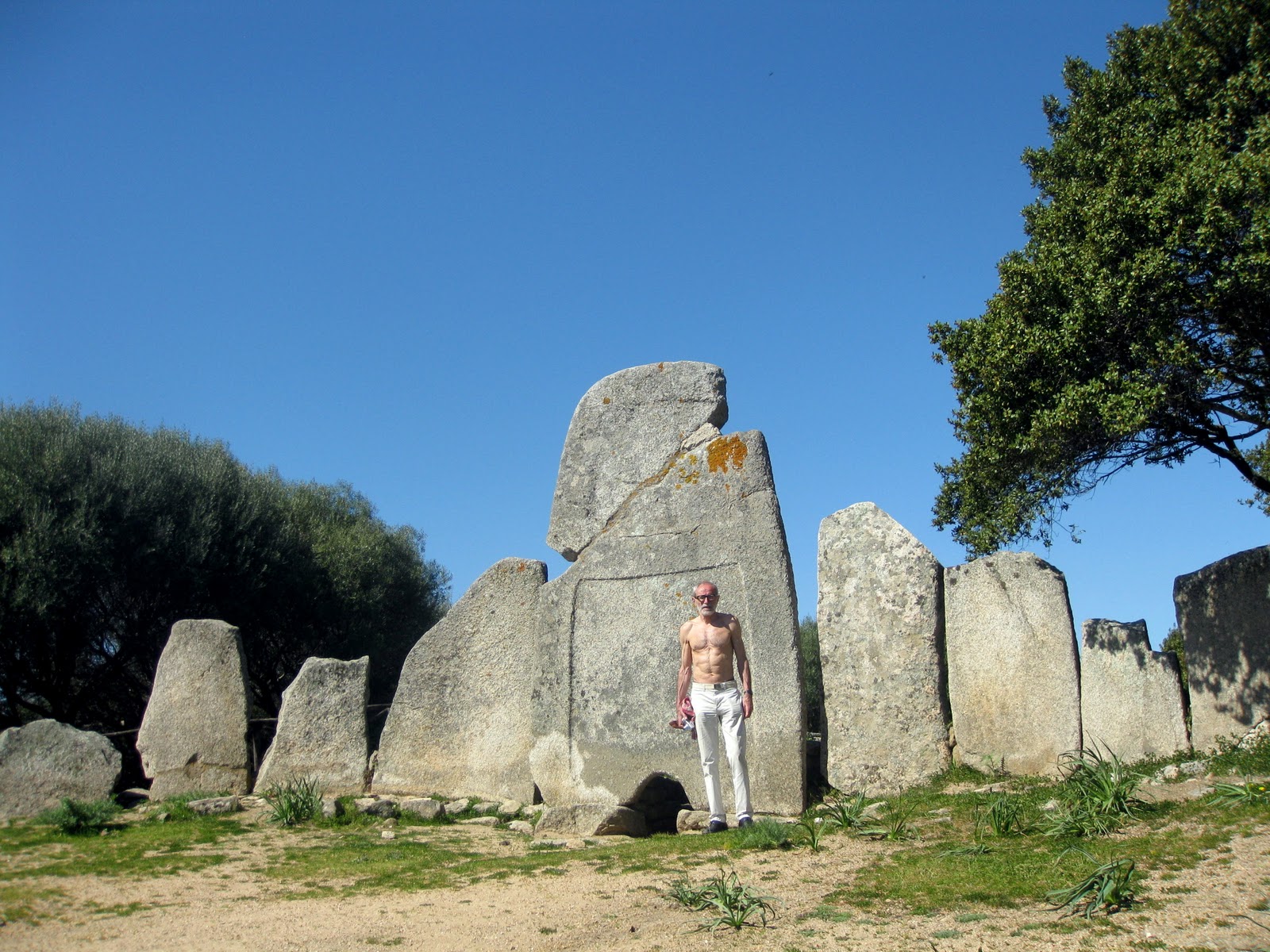
Tomb of the Giants
The Tombs of the Giants, so-called because of the 4-metre high central stella, were common burial sites for the Nuragic people, of the later era (1800-1300 BC in many cases). Through the tiny arch in the central stella you now see the sky between slats of stone, but in those days it was the world of the dead. The peoples were said to fear the dead so much that they destroyed their weapons to keep them from rising up and taking vengeance on the living.

Santa Teresa Gallura
And finally the lovely Santa Teresa Gallura, a town at the northern tip of Sardinia, has taken flight with holiness as it flies out toward the sea, just facing Corsica, with  brilliant wildflowers. And St. Vittorio, the church in the central square is decorated inside with larger than life-size angels, that mount up to Christ high above, like a psychedelic dream on the edge of the turquoise sea.

samedi 2 avril 2011

The Nuraghe of the Bronze Age


It was only late afternoon when we found the Nuraghe, after a day of the lavish and empty Costa Smeralda (the bling bling coast). I was having a touch of heat stroke in the village of Arzachena, a sleepy but refreshingly normal place where the workers of the jet-setters live. Its box-like houses of stone and stucco baked under the sun, where the inhabitants spoke slowly enough that we could understand their Sardinian tongue. Groups of men lounged in the bands of shade.

Il Fungi, shelter from 3500BC
On top of Arzachena perches il Fungi, a gigantic granite rock shaped like a mushroom which is revered by its pious concrete setting. But under il Fungi sat some scruffy Sards with their dog and their beer. A capacious umbrella of densest granite, it provided shelter for Sardinians in 3500 BC. We climbed up against the punishing brightness of the sun and saw Gallura's fields all around. Then a thick-set woman at the tourist office showed us how to reach the other prehistoric ruins nearby.

Tomb of the Giants, 1800 BC
The Tomb of the Giants had a large empty parking lot and closed ticket office, but two Sardinian women, strolling through cow pastures and gathering plants, showed us where the Tombs were. Then they strolled over too, circling the megalith with hands held to their hearts. I would be strolling there, too, if I lived here.

The tombs date to 1800 BC, an early stone-covered passageway for burial, with added stellae from around 1200 BC. A small semi-circular doorway symbolically provides a threshold to that world of the dead that the Nuraghe were said to revere and fear. Bands are carved into the tall (4 meters) central stellae. The tomb sits by vineyards, in a grove of trees that provide deep cool. The feeling there was profound.

Nuraghe settlement, 1300 BC
A few hundred meters further was the center of the Nuraghic city that had covered 5 hectares of land in 1300 BC. A stone tower of heavy granite that had been painstakingly split, using wood and water to slowly break the giant rocks into flat surfaces, rose above lower stone cylinders. The stones were immense and misshapen, but fitted together skillfully enough to have withstood 3500 years of existence. Before the the chieftain's tower spread a complex of 2 smaller towers and workshops where the community baked, created pottery and stored food. Now trees grow inside the mossy stone circles, which include a kiva-like meeting hall where something like writing has been found. These peoples had commerce with the Egyptians and the people of Palestine, as well as the Mycenean Greeks. Pre-literate and pre-coinage, the Nuraghic people have left their settlements all over the island. Here, in Gallura, la Prighione as this one is called, as the network's center.

One of the rock's many faces
Further on we hiked, in the soft evening air, past stone farmhouses and inquisitive red cattle, an old sweet-eyed dog, through groves, past countless varieties of wildflower, up a rocky hill among huge rocks sculpted into arcs and twisted into faces by time. The sky was softening into pink hues and all of Gallura was spread beneath us, farmland and trees. Up the stony path, on precarious granite boulders, we climbed a Bronze age staircase like the boulder-stairs of the Prighione. Under a massive umbrella of a rock whose every facet seemed to be a Mt. Rushmore of prehistoric faces, hidden by the trees, was a temple, walls high, lintel intact, a doorway into a space of sacred purpose.

Temple, 1500BC
High up, above daily life, this temple has communed with the sky for these thousands of years.

The archeological museum at Sassari tells these tales of Sardinia beginning with 5000 BC, with jewelry and elegant pottery from the Nuraghic age and before. Then it details the incursions of Etruscans, Phoenicians, Carthaginians, Romans, and into the medieval days of the Aragonese and Genoese. All rooted in this lush land.