mardi 26 avril 2011

Cagliari

Cagliari is Sardinia's largest city with 140,000 inhabitants, breezy and lovely and splashed with sun. The fierce Barbagian spirit is missing here, though there is much to be proud of, but the architecture is largely due to the hated Spanish domination under which Sards were chased from the citadel of the city, even before the Jews were chased away after the directives of the Catholic Spanish Empire. Whereas we are traveling geeks following the ephemeral traces of time, most travelers would rightly see Cagliari as a fabulous place to get sun and sea and Mediterranean leisure.

The Citadel
Cagliari (KALyari)'s history began as a Phoenician port that came under Carthaginian rule, but under the Romans it became a real metropolis with an amphitheatre and water supply and paved roads on the flat coastal plain. The Pisans, who took over Cagliari from the Genoans in 1258, built up the hills to create fortified citadels, with a wall around the sector of the city still called Castello. Aragon conquered it next, bringing in Catalans and Majorcans as well to fill public positions. By 1328 a harsh trumpet announced the curfew, that all Sards must get out of il Castello on pain of severe punishment. The darkest age began in 1479, when Ferdinand the Catholic succeeded to the Spanish Empire.

We drove in after a morning jog on the beach, greeting all and sundry (oggi bella!). Cagliari is a little like San Francisco, airy and lovely, the via Roma that faces the port lined with elegant facades like Florence or Venice but more recent. And then we climbed up winding pedestrian streets where laundry hangs by a shop of gleaming Buddhas and an Indian grocery. A school boy's t-shirt read "I (heart) Sex and Drugs." At a sunny square a huge Roman general in bronze urged his soldiers on, marking with a Roman column Carlo Felici, the north-south former Roman road that is today one of the major highways.

St. Michele
St. Michele was a lavish Baroque Jesuit church with polychrome Genoese marble work and high Spanish cage-like galleries from which nuns and noblewomen hid from view as they attended services. As soon as we sat in a pew, a soft-spoken and well-informed guide introduced himself, and presented the paintings of Sardinian artists of the 17th and 18th.

Everywhere the cruel Spanish had created the grandeur of a the Mediterranean port, everywhere they had exiled and imposed penury on the Sardes. They were succeeded by the House of Savoie, benevolent rulers of the 18-19th c, whose portraits are in the Vice Regio Palace where outstanding grafitti art was also displayed.

Up the hill we climbed, where the climate was more sublime, to the Botanical Garden, simple and academic, an Italian Jardin des Plantes of seemingly 1000's of plants, and a Roman cistern where actors took their refreshment between acts at the ampitheatre. The amphitheatre is just outside the garden, its beauty marred by stadium seats and scaffolding. It seats 10,000, and its underground passages once used for the beasts of the spectacles were later used in WW II as bombing shelters and even homes. We passed students from the nearby university and old people, self-absorbed in the Mediterranean sun.

We climbed through the original white rock boulders of the city's summit, past the prison where laundry hangs from the bars, and onto a rocky abutment which overlooks the city and fort. We strolled down through the public garden, utterly simple and beautiful, with herbs growing and a little lending library in the sun and shade. Now on the eastern side of Cagliari we descended terrace by terrace with views of the city below. The terraces are bars, and people recline with their cocktails on boxy furniture.

Tower of the Elephant
We continued on bumpy medieval roads down to the Museum Citadel and found the only open restaurant in the area, with an enchanting terrace, where we ate focaccio in the windy sun. The tourist season hadn't begun, but at InfoPoints overqualified staff eagerly plied us with maps and brochures. We passed the smooth Genoan Tower of the Elephant, with its carved eponymous beast on a bracket, while high above are the brackets where cages swung with the weight of the chopped heads in them, during the dark years. The Cathedral Santa Maria is elaborate and baroque, but most interesting were the four stone lions inside, gleefully and cruelly pinning down some antique beasts, as well as the extraordinary 12th c. carved Pisan pulpits.

Down we went into the old Jewish ghetto, with its close dark streets, always stopping at the terraces where people lounged, the most beautiful of which is the Bastion San Remy. We kept moving down the medieval stone streets, past a square where children played dodge ball with fond coaches. Ornate churches were filled with the drone of mass, its glum call and response, at this evening hour when everything reopens.

San Saturnino
San Saturnino

We went to Cagliari once more toward the end of our trip, to see the beautiful white stone San Saturnino, that had been built in the 6th c. and extended by the Victorini monks in the 11th. Cats gazed at us from the safety of the archeological dig, either nursing their litters or nestling together. Again we went up the rocky road to the Museum Citadel to see the Archeological Museum, which contains the treasures unearthed in the places we had been visiting throughout Sardinia. The Nuraghic art of the bronzetti, thin geometric bronze figures like tiny Giacometti sculptures, from about 850-500 BC, are perhaps the most striking and most native of anything in this large collection of masks, statues, gravestones and tiny burial objects that have been excavated from Sardinia's old earth. The sea has also yielded Roman, Greek, Egyptian treasures and art from throughout the civilized world of those times. Exquisite jewelry, Egyptian and Roman and Phoenician and Carthaginian accompanied people to the underworld.
Carthaginian necklace

During lunch at the outdoor café we watched as a troup of young people carrying paper shopping bags whisked past us and up to the pinacotheque where we were headed to see the few paintings collected there. What happened next was surreal.

Mercury
Bastion San Remy
When we entered the museum the 20-somethings all stood there, as many uniformed guards as there were paintings, hovering over us as we stopped at each, fairly unremarkable, work. Large healthy young people, they stood at attention like military officers, but not at our service. One guy began giggling uncontrollably, another turned his soulful eyes toward me. We moved the next level down and two of the guys marched past us officiously to take their posts ahead of us, so we moved to a further level down. We looked up to see 5 or 6 young women's heads looming over the banister at us. Was this a joke? A happening? Performance art? We'll never know. As we left they gathered around us once again, shoulder to shoulder. It was the best thing we'd seen in the pinacotheque.

dimanche 24 avril 2011

Phoenicians in Sardinia

View from the promontory of Nora
The Phoenicians, merchants and fishermen who originated in Lebanon, came to southern Sardinia at what is now Nora about 800BC. Like the other Phoenician city Tharros in the west, Nora forms a promontory, with sparkling harbors on either side. The Phoenicians found abundant fish in the lapis waters, and could transfer their fishing boats from one harbor to the other, protecting them from high winds. Travelers of the "known world," they brought with them abundant artifacts that have been found in the Nuraghic sites (including Mycenean, Egyptian and Semitic), and a written language. There is no trace of writing among the Nuraghic peoples (1500-800 BC) though one of our tour guides is positive that they must have had one, and that it is lost with the decomposition of writing surfaces. Perhaps the word "Nora" comes from the ancient word "Nuraghe." Or, according to classical tradition, Norax was a son of Hermes who founded Nora. A Phoenician tablet has been found at Nora, so far untranslatable because it seems to use the Phoenician alphabet to write in another language--perhaps the Nuraghic one. On it is the first known use of the word for Sardinia, Sardara.
Phoenician tablet mentioning Sardinia

Nora
Nora was therefore an important port of call for the Phoenicians, so close to the north of Africa, which would bring it under the Carthaginians in 5th-3rd c. BC , until the Roman conquest began. The Carthaginians are called "Punic" by the Sards, referring to their status as a Phoenician colony, but distinguishing them as the more warlike invaders. In 283 BC Nora became the seat of the Roman governor during the late Republican era, and "caput viae", i.e. the place from which measurements were taken. Nora was a rich and prosperous Roman city at least until the Vandals occupied Sardinia, between 456 and 466 AD. The city was probably abandoned because of Arab raids, 7th c AD, that forced the coastal population to retreat inland.

The heart is a Carthaginian signature, in a Roman mosaic
We would visit Tharros--the most important Phoenician city--later in the trip, at twilight after the ticket office closed, accompanied only by a sweet-faced dog who, content with our presence, lay down to sleep on the windy point. But first we saw Nora in the full heat of the day, rewarded by the knowledge of one of those intense, quiet and scholarly guides. Round-faced, in shorts and a baseball cap, he switched softly between English and Italian to explain the ruins as we wandered through their thousand or so years of being Phoenician, Carthaginian and Roman. There was a Roman theatre--not amphitheatre, but an artistic forum--near temples of the Phoenician fertility goddess Tanit, near workshops built in Carthaginian architecture, and even a sign of Carthaginian workmanship on the Roman mosaics. A clay statue of a boy with a serpent has been found, which is believed to be the oracle which spoke from one of the temples.  In the final years Nora became a Roman resort with three thermes, as the center of power moved to Cagliari.

Oracular boy of Nora
Another major Phoenician settlement is on Mount Sirai, which was from the 7th c. BC an extensive necropolis, though only 270 bodies have so far been excavated. Carthaginian burial chambers succeeded the Phoenicians. We could descend into these stone vaults by stairways, and enter various rooms, sometimes with columns. There, as near Nora and later at St. Antiochus, we would see the remains of tophets.

Tophets have long been considered burial sites where infants, sacrificed to Ba'al by being burned alive, are buried. This would have been a Carthaginian practice, not Phoenician. The practice is mentioned in the works of Plutarch, Diodorus Siculus, Tertullian and others, but not in the writings of Livy or Polybius. It is mentioned in the Old Testament, and by rabinnical commentators. But in Sardinia, the information on tophets is different, of:

"a sacred place where stillborn children who died before integration into the community were buried. The divine protectors are Baal Hammon and his female partner, Tinnit. It was an open space around an altar built on a rock outcrop, which would later become a temple, with the remains of children in cinerary urns, and steles for various deities."

At first I considered that the Sardinians couldn't stomach the idea of child sacrifice, particularly those who would have aided in the excavations. But in the Cagliari museum tophets are clarified as follows.

"Till a few years ago, the tophet was supposed to be the place where the children of the most important families in the city were sacrificed to give welfare to the city. Now, new studies of the ashes, of the inscription on the stele and of the ancient written sources, bring us to consider the tophet a cemetery where are buried the children born dead or dead shortly after birth."

Apparently, there is wide disagreement among scholars, but, according to Wikipedia, there is general agreement that there were some Carthaginian places where child sacrifice was practiced.

Temple to Ashtarte, Mt. Sirai
Egyptian fertility god, Bes
Mt. Sirai also has a temple to the Phoenician goddess Ashtarte, that was an open-air altar from the 8th c. BC, over a pre-existing nuragic tower and a water tank. In the 3rd c. BC an actual temple was built, with an 8th c. BC statue of Ashtarte. Later Demeter replaced the Phoenician goddess, while the male deity was Bes, the Egyptian fertility god.

The Phoenician temple and houses were constructed using rhyolite, or the local red marble, which I found moving--it is a semi-precious stone I often wear.

samedi 23 avril 2011

Barbagia and Orgosolo

The high forested center of Sardinia has been called Barbagia since early times, since the Sards escaped to its mountain fastness to rebel against the Phoenicians, and it has never been conquered. In modern times convicted criminals escape to the protection of Barbagia, like Corsican terrorists taking to the maquis, and are allowed one day a year of amnesty to visit their families. But if they are caught on any other day, their sentence becomes doubly severe. This is the land with laws of its own, feuds and vendettas, whose capital Nuoro only became incorporated in the 19th c. The men I saw, on our café stops, had expressive eyes and an old-fashioned courtesy toward women. The women's toilet, though not the men's, is always locked with a key.

Nuoro, ironically, has the feel of Europe with its sunny cafés where men of a certain age discuss politics in their fine woolen suits. Leftist papers were more in evidence, as well as modern shops and political graffiti. Spring comes later here, and the day we passed through Nuoro was sunny and dry and brilliant with a cool wind and tiny buds on the large oaks on winding hilltop roads, not a good route if you're prone to carsickness. (I am.)

The mountaintop villages were mostly closed, so we found a limonata on a sun-drenched terrace where the rough-looking but courteous men were more or less working in the stillness.
On the other hand Orgosolo is, you could say, always open. This rustic mountain setting became an international art center when Milanese anarchists embedded here in the 60's, leading to an outpouring of grafitti that is more mural art about resistance in all its forms. The subjects include Vietnam, coups in Latin America, the American Indian, 9/11, etc. To uphold their reputation of rebelliousness, presumably, the inhabitants seemed completely hostile. 

Later we would drive to lower Barbagia, through a herd of sheep rushing frantically together, their bells clattering, the little lambs tiny and spotted, the adults with shaggy coats, driven by two men who were not nearly as amused as I.

But first,


Triangle Shirtwaist Factory Fire

Orgosolo


Orgosolo

vendredi 22 avril 2011

The Spanish in Sardinia


Genoan tower, Santa Teresa
The proud era of the four autonomous Judicat of Sardinia (see "The Romanesque in Sardinia") came to an end when they requested help from the Pope, to protect against the incessant incursions of Barbary pirates. The Pope sent Genoans and Pisans, who built fortifications and churches and then availed themselves of the land itself, except for the Judicat of Arborea which would remain a defiant force to be reckoned with.

Capo di Testa
But it was to Spain, in her ascent as a world power and stronghold of papal politics, that Pope Boniface gave Sardinia in 1297. The Pisans and Genoese fortified their holdings, but Aragon began to take Sardinia by conquest in the 14th c. The darkest years would come in 1479 when Ferdinand and Isabelle fully dominated the island. The Sards were gradually reduced to penury and marginalization in their own land during the 500-year occupation. Only the Judicat of Arborea held on, until 1478. (Arborea's most famous ruler was a woman, Eleanora, whose code of laws is still recognized as an important innovation in legal theory, including the inheritance of property by women and civil rights.) The Spanish protected Sardinia's coasts and left monumental gothico-catalan architecture (and then the fussy, often weird Baroque), but in doing so they crushed Sardinia's own culture.
Nuraghe Tuttoni

The cities that today retain strong Spanish touches are Castelsardo in the north, dominated by its dark stronghold of a castle, and Alghero, now a breezy sweet city of the northwest coast. (Cagliari is a third, but the largest city of Sardinia deserves its own chapter).

First, Castelsardo, our destination after visiting the ravishing northern coast. There we visited Santa Tersea di Gallura with her staunch Genoan tower confronting Corsica, where brilliant wildflowers crawled over rock and emerald grasses. We climbed to the tower and then down to the white beach where a few local sunbathers gazed at the gradients of turquoise waters. Then we walked under the fierce sun back uphill among the pastel houses, empty for the season, and had lunch on the church piazza of Santa Teresa. From there we followed signs to a Nuraghe and climbing among thistles and wildflowers, but our search was fruitless.

Nuraghe outside Castelsardo
From Santa Teresa we drove west to Capo Testa, a natural preserve with white beads of paths winding up and down among boulder forests bejewelled with abandoned stone walls.

We drove on to Nuraghe Tuttoni at the end of a long, dirt road, which was piled high in several levels with rocks tumbled inside, a strong outer wall smoke-blackened, all wound round with fragrant and thistly growth so that it was impossible to find the entrance. The day was spent climbing like kids, balancing on rocks and pushing through brambles.

Castelsardo
Finally we drove to the point of land where Castelsardo presides, passing a staunch unnamed Nuraghe, solid as a Genoan tower in a field of clanking sheep. Lambs gambolled together at the far edge in a glade.

in Castelsardo
Castelsardo is a medieval city perched above an ugly modern development. Half in ruins, it presides with great dignity over the sea. In the medieval Byzantine church Santa Maria a group of local men rehearsed the famous local polyphonic singing. Its closely spaced, dissonant notes move stepwise, apart and together, almost resolving in major chords then moving again into dissonance. A haunting tenor sang an aria like a Gregorian chant, moving around each note, never resting on firm ground. The other men stood in a close circle, sounding harmonies. Other men sat and listened, in the church with its intriguing beauty of Spanish altars and moving crucifixes and saints, and a pulpit of painted wood in Spanish Baroque that seemed as unsettling as the singing. Outside terraces of the medieval walls looked down on picnickers in the winding pathways among tender grasses at the edge of the sea. A sea gull nested patiently in the wall near us.
rehearsing harmonies, Castelsardo

Though there is a museum in the medieval castle, the hour was late and it was time for the stomach-turning ride back among the high winding roads in the black night.

Alghero was a separate trip that we took via the Romanesque churches of the Loguduoro (see the posting, Romanesque in Sardinia). It is a breezy medieval town with Aragonese towers, but with the warmth of Italy, informal and filled with chatting, wandering people. It is like the coastal Moroccan port of Essaouira, with its light touch and easy comforts. Young people scampered down to lichen-covered rocks outside the sea wall, cats fished, people lingered over gelato and drinks on terraces at the cool, misty edge of the sea. The sunset was swathed in beige bands of mist, the obscure sky a relief after such fierce sun.

San Francesco, Alghero
We had pizza and salad where many others had gathered in a plain pizzeria, served by yet another incredibly handsome Italian. The men here are strikingly beautiful, either dark-lashed or more ruddy with the etched features of Roman gods. All the pizzas were being turned out, every few minutes, by one man at an oven, and to perfection. People wandered in the evening intent in their lively conversation.

We woke the next morning in lovely Alghero, breezy and sea freshened, sunny medieval streets that chase away forgotten gloom. We sat up in fine cotton sheets covering fine Italian wool and after morning exercises we took off to see three beautiful churches, originally gothico-catalan, now overlaid more or less completely with Baroque. Throughout Sardinia, amidst the subtle, exquisite architecture of the gothic usually stands a plump writhing Baroque altar, as if a statue of the Queen mother were plunked everywhere amid the austere churches.
St. Michele, Alghero

The gothico-catalan San Francesco retains most of its original form, with its spare monastic cloister. The Cathedral Santa Maria and the church St. Michele have high vaulted domes, a la Rome, with older Catalan altars remaining. Most of the Jesuit church of St. Michele was Jesuit, had been stripped down to raise funds for an academy.
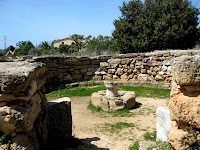

Nuraghe Palmavera today
Nuraghe Palmavera ~1300BC
We strolled by the old military towers, outfitted with replicas of medieval weapons, but Algherans weren't interested in tourists yet. So we drove out, hugging the brilliant coast, on our way to the Nuraghe Palmavera. Long before Sardinia was a pawn of the power struggles of medieval Europe, there was the Nuraghe civilization (1500-800BC). Nuraghe Palmavera is presented with elaborate drawings and explanations, so we could envision the lives of these Bronze age people. We climbed round and round the complex settlement, feeling the stillness of the age-old stones.