samedi 23 avril 2011

Barbagia and Orgosolo

The high forested center of Sardinia has been called Barbagia since early times, since the Sards escaped to its mountain fastness to rebel against the Phoenicians, and it has never been conquered. In modern times convicted criminals escape to the protection of Barbagia, like Corsican terrorists taking to the maquis, and are allowed one day a year of amnesty to visit their families. But if they are caught on any other day, their sentence becomes doubly severe. This is the land with laws of its own, feuds and vendettas, whose capital Nuoro only became incorporated in the 19th c. The men I saw, on our café stops, had expressive eyes and an old-fashioned courtesy toward women. The women's toilet, though not the men's, is always locked with a key.

Nuoro, ironically, has the feel of Europe with its sunny cafés where men of a certain age discuss politics in their fine woolen suits. Leftist papers were more in evidence, as well as modern shops and political graffiti. Spring comes later here, and the day we passed through Nuoro was sunny and dry and brilliant with a cool wind and tiny buds on the large oaks on winding hilltop roads, not a good route if you're prone to carsickness. (I am.)

The mountaintop villages were mostly closed, so we found a limonata on a sun-drenched terrace where the rough-looking but courteous men were more or less working in the stillness.
On the other hand Orgosolo is, you could say, always open. This rustic mountain setting became an international art center when Milanese anarchists embedded here in the 60's, leading to an outpouring of grafitti that is more mural art about resistance in all its forms. The subjects include Vietnam, coups in Latin America, the American Indian, 9/11, etc. To uphold their reputation of rebelliousness, presumably, the inhabitants seemed completely hostile. 

Later we would drive to lower Barbagia, through a herd of sheep rushing frantically together, their bells clattering, the little lambs tiny and spotted, the adults with shaggy coats, driven by two men who were not nearly as amused as I.

But first,


Triangle Shirtwaist Factory Fire

Orgosolo


Orgosolo

vendredi 22 avril 2011

The Spanish in Sardinia


Genoan tower, Santa Teresa
The proud era of the four autonomous Judicat of Sardinia (see "The Romanesque in Sardinia") came to an end when they requested help from the Pope, to protect against the incessant incursions of Barbary pirates. The Pope sent Genoans and Pisans, who built fortifications and churches and then availed themselves of the land itself, except for the Judicat of Arborea which would remain a defiant force to be reckoned with.

Capo di Testa
But it was to Spain, in her ascent as a world power and stronghold of papal politics, that Pope Boniface gave Sardinia in 1297. The Pisans and Genoese fortified their holdings, but Aragon began to take Sardinia by conquest in the 14th c. The darkest years would come in 1479 when Ferdinand and Isabelle fully dominated the island. The Sards were gradually reduced to penury and marginalization in their own land during the 500-year occupation. Only the Judicat of Arborea held on, until 1478. (Arborea's most famous ruler was a woman, Eleanora, whose code of laws is still recognized as an important innovation in legal theory, including the inheritance of property by women and civil rights.) The Spanish protected Sardinia's coasts and left monumental gothico-catalan architecture (and then the fussy, often weird Baroque), but in doing so they crushed Sardinia's own culture.
Nuraghe Tuttoni

The cities that today retain strong Spanish touches are Castelsardo in the north, dominated by its dark stronghold of a castle, and Alghero, now a breezy sweet city of the northwest coast. (Cagliari is a third, but the largest city of Sardinia deserves its own chapter).

First, Castelsardo, our destination after visiting the ravishing northern coast. There we visited Santa Tersea di Gallura with her staunch Genoan tower confronting Corsica, where brilliant wildflowers crawled over rock and emerald grasses. We climbed to the tower and then down to the white beach where a few local sunbathers gazed at the gradients of turquoise waters. Then we walked under the fierce sun back uphill among the pastel houses, empty for the season, and had lunch on the church piazza of Santa Teresa. From there we followed signs to a Nuraghe and climbing among thistles and wildflowers, but our search was fruitless.

Nuraghe outside Castelsardo
From Santa Teresa we drove west to Capo Testa, a natural preserve with white beads of paths winding up and down among boulder forests bejewelled with abandoned stone walls.

We drove on to Nuraghe Tuttoni at the end of a long, dirt road, which was piled high in several levels with rocks tumbled inside, a strong outer wall smoke-blackened, all wound round with fragrant and thistly growth so that it was impossible to find the entrance. The day was spent climbing like kids, balancing on rocks and pushing through brambles.

Castelsardo
Finally we drove to the point of land where Castelsardo presides, passing a staunch unnamed Nuraghe, solid as a Genoan tower in a field of clanking sheep. Lambs gambolled together at the far edge in a glade.

in Castelsardo
Castelsardo is a medieval city perched above an ugly modern development. Half in ruins, it presides with great dignity over the sea. In the medieval Byzantine church Santa Maria a group of local men rehearsed the famous local polyphonic singing. Its closely spaced, dissonant notes move stepwise, apart and together, almost resolving in major chords then moving again into dissonance. A haunting tenor sang an aria like a Gregorian chant, moving around each note, never resting on firm ground. The other men stood in a close circle, sounding harmonies. Other men sat and listened, in the church with its intriguing beauty of Spanish altars and moving crucifixes and saints, and a pulpit of painted wood in Spanish Baroque that seemed as unsettling as the singing. Outside terraces of the medieval walls looked down on picnickers in the winding pathways among tender grasses at the edge of the sea. A sea gull nested patiently in the wall near us.
rehearsing harmonies, Castelsardo

Though there is a museum in the medieval castle, the hour was late and it was time for the stomach-turning ride back among the high winding roads in the black night.

Alghero was a separate trip that we took via the Romanesque churches of the Loguduoro (see the posting, Romanesque in Sardinia). It is a breezy medieval town with Aragonese towers, but with the warmth of Italy, informal and filled with chatting, wandering people. It is like the coastal Moroccan port of Essaouira, with its light touch and easy comforts. Young people scampered down to lichen-covered rocks outside the sea wall, cats fished, people lingered over gelato and drinks on terraces at the cool, misty edge of the sea. The sunset was swathed in beige bands of mist, the obscure sky a relief after such fierce sun.

San Francesco, Alghero
We had pizza and salad where many others had gathered in a plain pizzeria, served by yet another incredibly handsome Italian. The men here are strikingly beautiful, either dark-lashed or more ruddy with the etched features of Roman gods. All the pizzas were being turned out, every few minutes, by one man at an oven, and to perfection. People wandered in the evening intent in their lively conversation.

We woke the next morning in lovely Alghero, breezy and sea freshened, sunny medieval streets that chase away forgotten gloom. We sat up in fine cotton sheets covering fine Italian wool and after morning exercises we took off to see three beautiful churches, originally gothico-catalan, now overlaid more or less completely with Baroque. Throughout Sardinia, amidst the subtle, exquisite architecture of the gothic usually stands a plump writhing Baroque altar, as if a statue of the Queen mother were plunked everywhere amid the austere churches.
St. Michele, Alghero

The gothico-catalan San Francesco retains most of its original form, with its spare monastic cloister. The Cathedral Santa Maria and the church St. Michele have high vaulted domes, a la Rome, with older Catalan altars remaining. Most of the Jesuit church of St. Michele was Jesuit, had been stripped down to raise funds for an academy.

Nuraghe Palmavera today
Nuraghe Palmavera ~1300BC
We strolled by the old military towers, outfitted with replicas of medieval weapons, but Algherans weren't interested in tourists yet. So we drove out, hugging the brilliant coast, on our way to the Nuraghe Palmavera. Long before Sardinia was a pawn of the power struggles of medieval Europe, there was the Nuraghe civilization (1500-800BC). Nuraghe Palmavera is presented with elaborate drawings and explanations, so we could envision the lives of these Bronze age people. We climbed round and round the complex settlement, feeling the stillness of the age-old stones.

jeudi 21 avril 2011

Spring in Sardinia

Spring in Sardinia. We arrived just on the cusp, and for the first few cool days we thought it had been a mistake. In Olbia we had a ground floor apartment in an old stone and stucco building in the narrow cobbled streets of the medieval center. In the morning, as the Mediterranean sun flooded the nearby port, our apartment was dark and cold. Outside the sweet air of dawn brought birdsong, while we huddled in darkness.

Across from us an older Sarde woman stayed inside her small dark house all day--we could clearly see her flat screen TV on from early morning, what they call the "cathodique religion." She was visited frequently by a small man on a bicycle, perhaps her son. When he left she came out on the narrow street to watch after him long after he had disappeared. Life was titrated in stingy doses through those close cobbled streets, whereas when we would move (halfway through our journey) to Cagliari, to a spacious beach condo of marble and slate, it would burst upon us with an almost unbearable intensity. But we began only at the cusp of it all.

People were taciturn but smiled easily. Walking at sunset along the bay the mountains were etched in crystal air even as a slight haze clung underneath soaring pink clouds that piled into heaven. History seemed to sit like a foreign presence. We heard little about personages, stories or memories. It felt as if those stories were in the villages themselves, in a language we don't understand, and in legendary vendettas and feuds that we could never understand. We saw timeless fields and sheep and newborn lambs frolicking, beautiful brown and white cattle on idyllic slopes.  We felt a remoteness of the land, its people and its secrets.

And then: Spring. Incessantly perfumed air, baby animals that had just been born, dewy tender grasses growing through the crevices in the Nuraghe--and the wildflowers. To my untrained eye, these are but a few of the flowers throwing their fragrances all about us:

Mostly brilliant yellow, in contrast to the indigo and turquoise sea, like the reverse of camouflage, but also: hydrangeas, red poppies, lavender poppies, cacti blossoms in crimson and yellow, succulent blossoms in neon magenta, mimosa, wisteria, blue blossoms of flowering rosemary, yellow blossoms of flowering fennel, tiny pink orchids, some of them striped, bristling stalks of pale star-shaped blooms, sometimes divinely fragrant, in other places smelling vaguely like dog pee; daisy-like marigolds, deep purple azaleas, fragrant red-violet blossoms in bushes of enormous geraniums, the tender heady yellow blossoms of wild freesia--everywhere, but it is called here the flower of Corsica; brilliant red violet jacarandas and similar blossoms on faux-plum trees, hollyhocks and sturdy zinnias of a violent orange; purple thistles and fragrant bushes of marguerites, and red-violet blossoming thyme. And apple blossoms, and the overwhelming fragrance of orange blossoms. I can only name part of what surrounded us. And I'm not even sure of their names.

Then there were the baby animals: mostly lambs, who really did frolic as if their legs propelled them in near somersaults; tawny handsome calves; piglets who ran toward our car while their huge mother backed off; beautiful young asses with markings like antelope.

We stopped by Costa Paradiso, which was once a hippy haven and is now a gated community with international real estate signs everywhere, only to see an immense wild boar and her little babies scamper up the steps of the climbing homes and disappear. They are very intelligent creatures.

A magnificent white horse who seemed like a unicorn--we spotted each other from afar. He galloped back and forth in his space, and fixed me with a direct gaze. I longed for him. We watched each other across a field. Then we drove off.

Puppies tumbled around their fierce mothers, and the stray cats who were not pregnant nursed kittens.

Then we left just as the religious festivities were to begin. Any Sard we spoke with, even our soft-spoken intellectual guides who seemed like scholars with a fierce pride for their island, were excited. They would take part, they would walk in a procession for four days from one church to the next, as mannequins were carried, dressed in finery none of these people would ever possess. It was, to them, being Sard.


But we came only at the cusp.

mercredi 20 avril 2011

Sassari, Immigrants and Artifacts

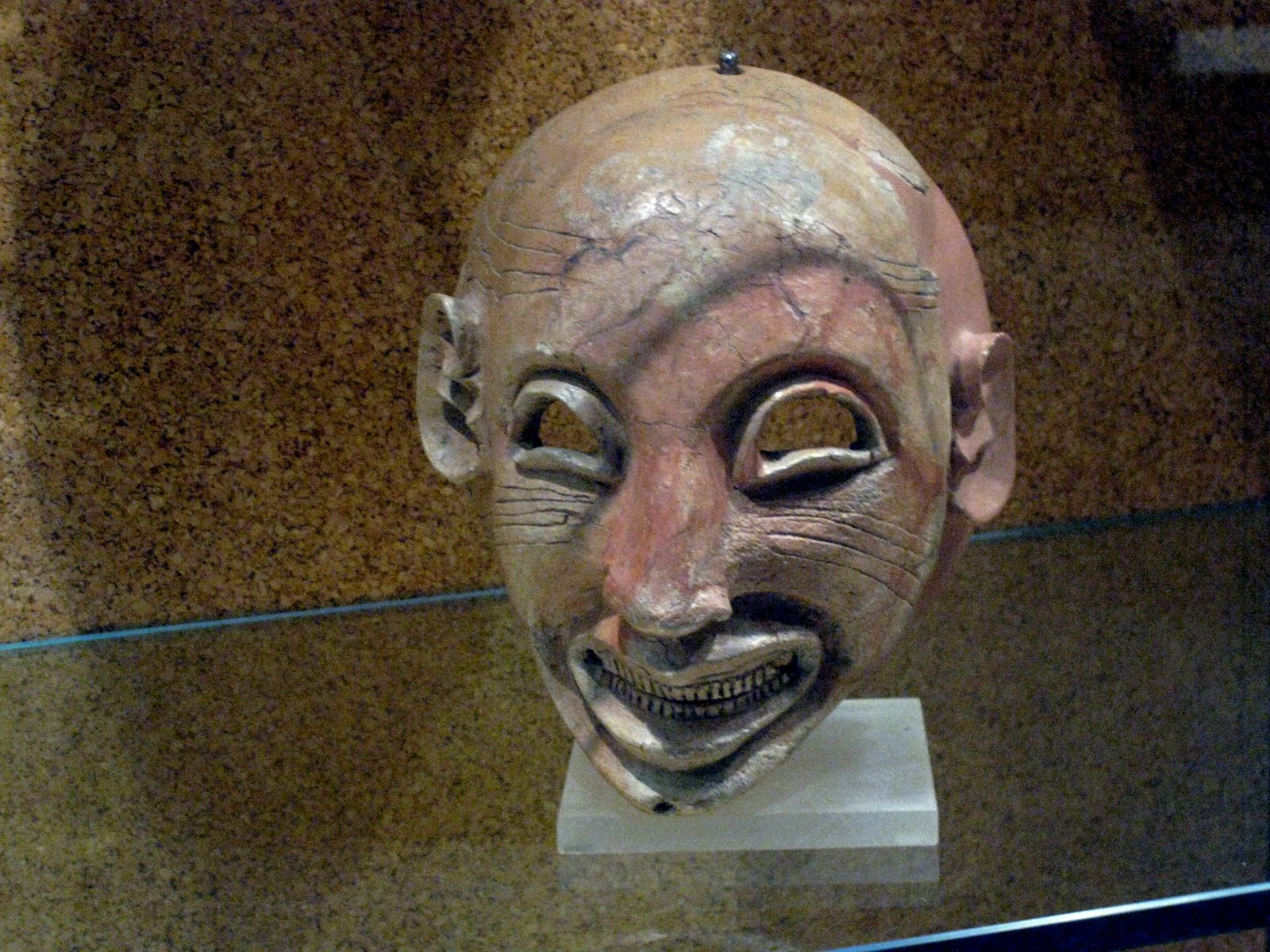
Some of the oldest and strangest things in the land of the Sards, aside from the 3,000-year old ruins lying by the side of the road or in fields of sheep or cattle, are in the archeological museums at Sassari and Cagliari. Those visits bookended our trip, helping us make some sense of the time-space continuum. Arrowheads and little proto-Venuses, from thousands of years BC, beautiful jewelry, and the elegant pottery of the Nuraghe, then the burial treasures that often came from Etruria or Egypt, Pheonician symbols like the Eye of Horus which is pure Egyptian, Carthaginian masks (I made a mask like this, once) and facinating beadwork, Roman statuary and mosaics--it's a long, long story. As mentioned in an earlier blog (Train to Sassari), our first day out we took a train across the northern interior to what had been the first free commune of Sardinia (1294), and remained rebellious and politically significant through the centuries of occupation. Sassari is the second largest city with 129,000 inhabitants.
Rosello Fountain, Genoan

The vista from the train station is disheartening, construction mixed in with the 13th c. wall of thick stones that now back up umbre and gold houses. We bolstered ourselves with espressos at a cheerfully glum cafe like those all over Europe. The first stop, at a 17th c. Genoese fountain, is magical, not for sculptural beauty, but for its bright white presence down a grassy slope where children played and sketched. It is the site of a spring divinity, a water source that has been used since the 13th c.

Gothic Catalan Palazzo
St. Nicholas Cathedral


Then we entered the streets, rough granite, whorled columns, and stodgy monuments of the gothico-catalon style, all mixed in with a grimey somewhat out-of-time city--not so much dirty as mired in a desolate quality, growing like a jungle around the remaining architecture of a medieval and Renassance past. We climbed up the honking Corso and then down narrow streets where centuries-old stone vaults grace the interiors of store fronts, and out to the splendour of the Duomo, the centra Cathedral of every Italian city. A fantasy of Spanish baroque, massive and fussy at once, its facade centers around a sour-faced St. Nicholas. Inside the main hero seemed to be a war-like young man on a horse. The piazza had charm and grace, bright yellow facades with clean baroque decor. Sidestreets were neat, like Sicily's Sicracusa, while the Corso was like Sicily's Catania, dark gloomy stone. Over the spacious main square stands Victor Immanuel, united Sardinia's first ruler, square and pig-like, facing a huge neo-gothic bank that looks Venetian.

Model of a Nuraghe, Sassari Museum
There were streets that radiating from the square that felt like the Cote d'Azur, weather beaten warm facades with green or brown shutters. Only one architectural fantasy stood out, bubbling with victorian-looking sprites and bright-eyed nymphs.

As we rested on a piazza a Senegalese woman approached, tall and elegant and open-faced, with long corn-row braids and her wares. The Senegalese are everywhere in Italy, with their baskets of batteries and socks and charcoal lighters, or crafts from Africa, or in her case leather purses. In Venice they carry big plastic bags of designer-bag knock-offs, as they do in Florence. When she approached us I said to her, "Lui, il est né a Dakar." Telling people that Jacques was born in Senegal is always a good conversation starter.

Greek Erotic Vase, found in Sassari
"Dove?" she kept demanding. Where? Where was he born? What hospital? What street did he live on? She wanted to have his every memory of his birthplace, where he had lived only briefly while his father worked as an engineer installing railroads for France. The history between France and Africa has not been pretty, and Jacques had spent his career apparently trying to compensate for it, as a development economist for the poorest countries in Africa. We quizzed her---how did she come? Her husband had brought her, he had a job in a restaurant. He was bringing her sisters. He must have had papers, she was lucky. No matter how homesick she seemed to be.

Bronzetti, ~1000 BC

"These poor Africans," Jacques would say as more and more Senegalese appeared whenever our car stopped at a traffic light, or as we walked down the streets or sat in a café. "Everyone's screwing them." Sometimes they seemed stolid and dignified even peddling their trinkets, sometimes mischievous and smiling. "They're not shy, Senegalese," said Jacques. In Cagliari a big man dressed in an exotic combination of a Muslim-style culotte and straw hat seemed to be a leader of a group of Senegalese chatting on the street. We trailed two of them in Nuoro, wearing jogging suits, talking about soccer in a combination of Woloff and French. "Actually, soccer's their favorite thing," said Jacques. "They must feel at home here." Most places teenagers would lounge in groups in sunglasses and languid poses of discontent. Their deep black velvety skin stood out everywhere. "They're living 10 to a room, sending every centime home to their families," said Jacques. Looking directly at them often caused them to disappear in the crowd. And at about this time the Italian news, wherever we happened on a TV in a restaurant, was of Berlusconi and Sarkozy teaming up in an anti-immigration initiative, shipping back stowaways who had landed, like most, on Lampedusa. While, unbeknownst to us, our femme de menage back in Paris, Albertine, was mourning her nephew, suspected murdered in a retalitatory killing in the growing civil unrest of her homeland, the Ivory Coast. It turned out, luckily, that he was released alive after the desperate pleading of his sister.

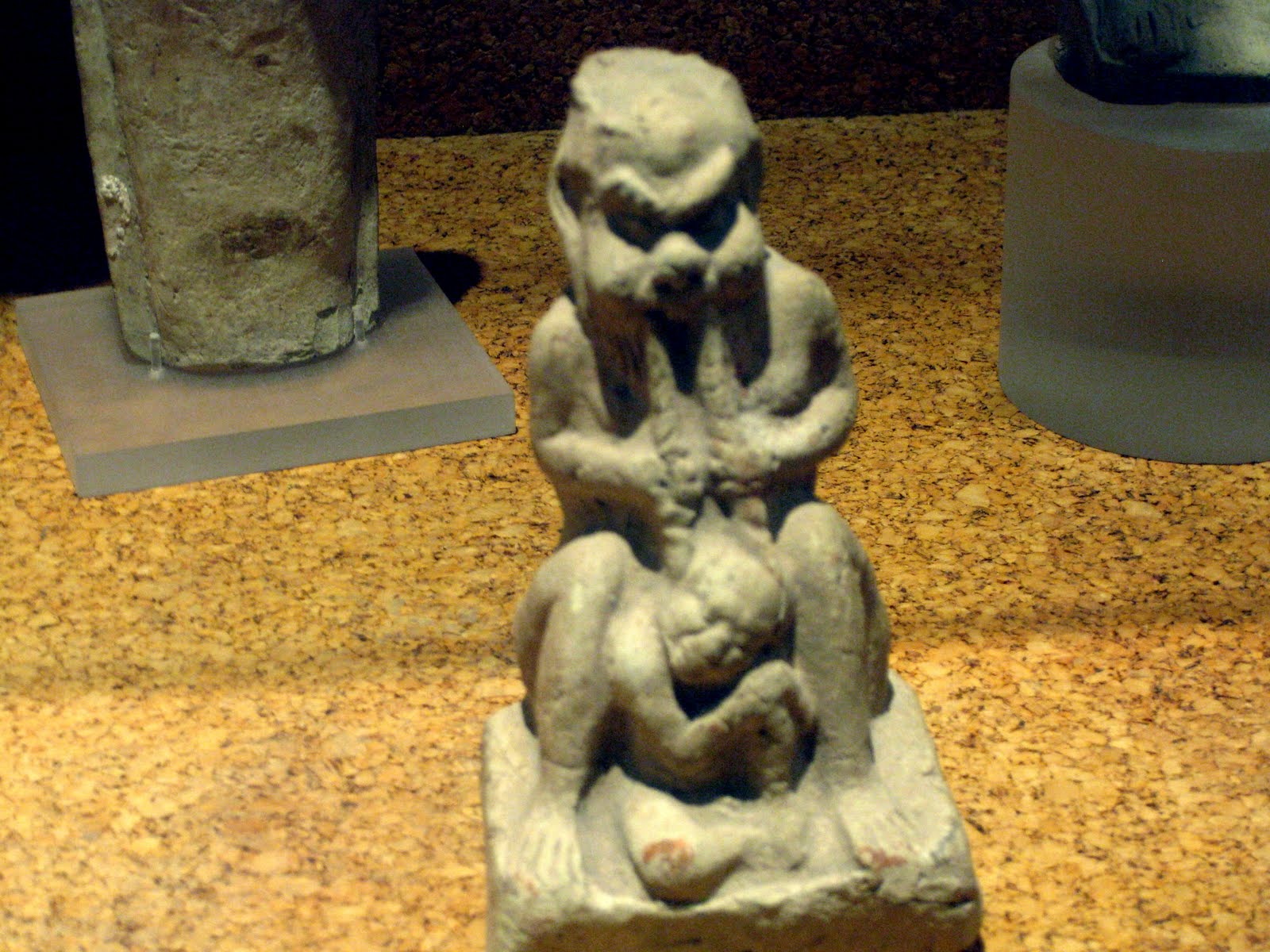
Local versions of Bez, fertility god of Egypt
And so, even as I clucked and cooed each time I saw a farm animal or a stray cat or dog, Jacques retaliated by clucking in babytalk every time he saw a Senegalese.

But we had come to Sassari for the museum, where Sardinia's history resides. It welcomes you with a modest charm, scattered boulders and a rustic garden. The artifacts begin at about 3,000 BC, the labeling system meticulous but obscure. And thus far, it was all new to us.

Carthaginian mask, ~300 BC
Bez
That was our first encounter with the strange, defensive mounds of the Nuragic age (1500-800 BC) and the jewelry and weapons found in ancient burial mounds and in the later Phoenician and Carthaginian graves. The old fertility goddesses, looking a little Humpty-Dumpty-ish, or the powerful Tanit goddess, who began as nothing but a triangle with arms, and Sardinia's own Babai, a father of fertility. Then there were gods from around the known world, Bez, the misshapen fertility god with the erect phallus from Egypt, tiny statues that had been buried with ancient Sardinians, of deities and animals, and friezes found at tophets, the gravesites of infants. Following these the more skilled while rather unfeeling Roman sculptures--Venus, Demeter, Mercury--and some unbeautiful mosaics. It was exhausting and bewildering, and we went out into the emerging sun, and the marvelous train ride back to Olbia.