lundi 17 décembre 2012

Montjuic and The Art Museum of Catalunya


Beautiful sunny day in November, on a Mediterranean mountain, Montjuic, that overlooks Barcelona. Once the Jewish cemetery, now a weekend escape from the city.

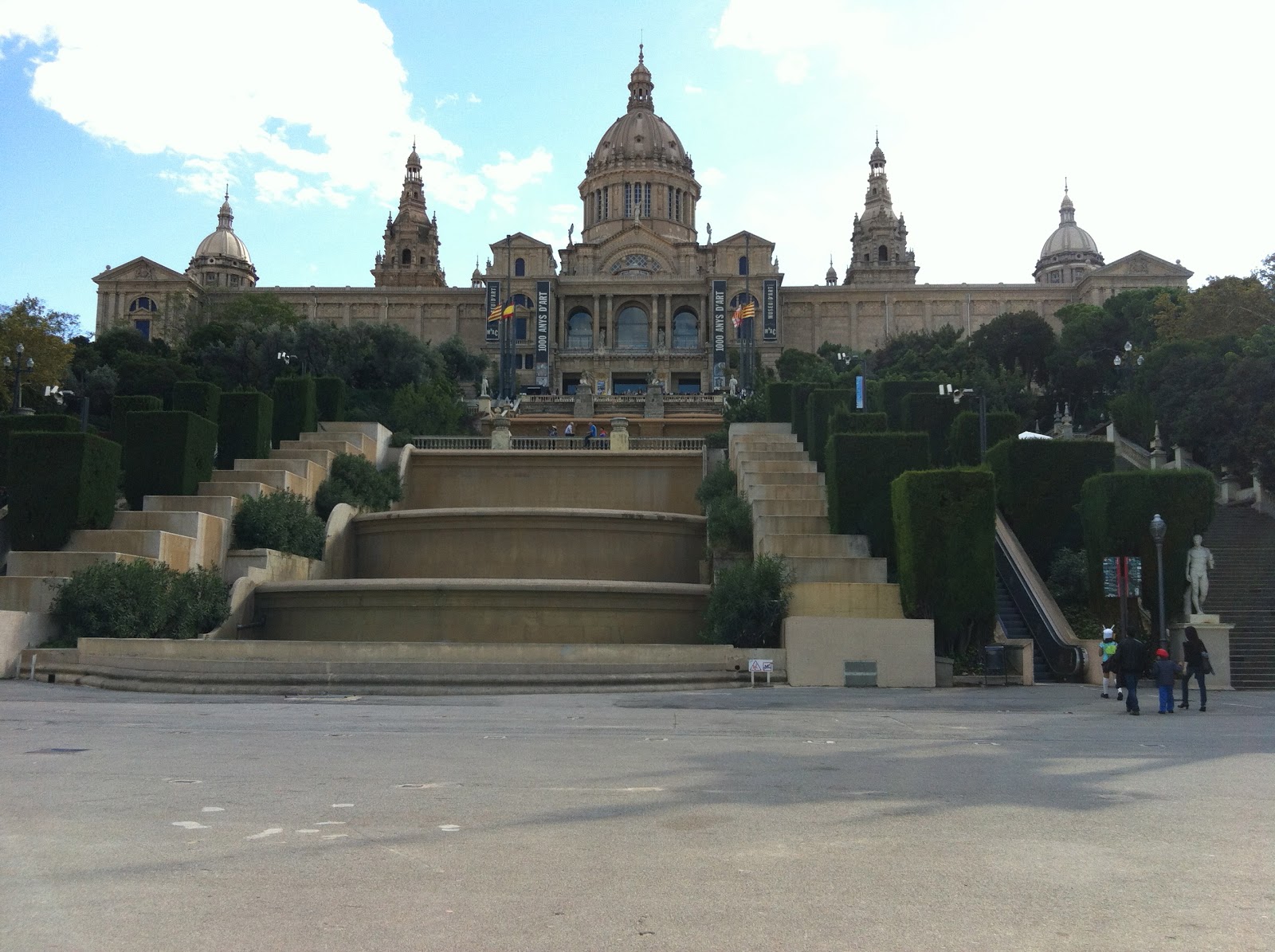
We climbed Montjuic in dappled light, up the grand staircase to the art museum of Catalunya---A Thousand Years of Catalunyan Art--- which surpassed expectations. Meanwhile a manga convention was taking place and Barcelonans in manga costumes streamed, with their axes and wings, up the hill across from the Spanish Baroque cupolas and multiple levels in tawny majesty.

Inside the museum, Romanesque church interiors had been leached from their thousand year old walls, and replastered into concavities in the museum. Looming primitive eyes in stoic peasant faces of saints, bestiaries of the same creatures we have seen at the Babylonian Ishtar temple, men in trance playing instruments and dancing, wide eyed, while a hand casts a heavenly ray on them.

School children were herded in and sat at the feet of these visions, and then sang to a dancing marionette playing a violin. It was a folk song, slightly Middle Eastern, that they knew well. As they noisily traipsed thru the Romanesque apses, we threaded our way around them, progressing through Byzantine influences--always the wide eyes upon us--to Visigoth fragments, some from the French side of the Pyrenees. We traversed the slow progress toward Western faces, from the large headed peoples on the capitals of the Barcelona hospital, to a 3/4 gaze as we made our way toward the gothic.

Peter with his key
The gothic art section was stylized in a slender aesthetic, altarpieces that seemed to painted on leather, painted with white saints. Marble statues of increasingly delicate Madonnas, retables mostly of martyrdom--slender little saints calmly being boiled, or skinned, or roasted--the wide-eyed faces increasingly expressive, introspective or remote, more and more anguished at the Passion, giving way to severe bearded patriarchs. Peter with his key, Anthony with his child, God becoming a baby with an increasingly gentle mother Mary.

Strong Catalan painting
International influences crept in--in fact, 12th c Madonnas look very Chinese, carved in wood with little caps, their robes folded rhythmically about them, their faces in serene meditation. Gothic retables, so difficult to find in situ, abound. The brilliant scarlet and gold of the Spanish church with delicate but severe Fathers. As the Renaissance approached, these faces acquire more creases, more character, more secular realities.

The Baroque brought a stark, brutal realism, the white wrinkled skin of the saint (being peeled off) contrasted with fierce suffering eyes. The great El Greco's John the Baptist, luminous skin stretched across a face with eyes frosted in ecstasy. Landscapes of Toledo seen from afar, a gleaming cradled city a little like today's Barcelona seen from Montjuic.
International gothic

El Greco
St. Bartholeme, de Ribera
Scenes of Barcelona then give way to a modernism like the Parisian avant-garde of the late 19th c. Workers sit exhausted in abandoned gardens, Spanish Renoirs and Pissaros. The great Maria Fortuny and his influences, paintings of Arabian deserts and a Sultana reclining, black slaves and odalisques. With modernism comes a little Picasso. Art deco furniture by Gaudi, luxurious whimsy, and across the hall the photojournalism of the Spanish Civil War, details of life in a concentration camp not far from Leran. Sculptures a la Maillol.

Further up Montjuic we wandered past the Olympic Stadium, in the footsteps of the greats with Michael Jordan's amazingly small foot from the 1992 Barcelona games. A series of rocks surrounded a gray frieze of the Korean who had won the marathon. Below, Gaudi's Cathedral, Sagrada Familia, loomed its tentacles over the otherwise industrial city that sprawled over the valley, surrounded by Mediterranean hills. We wandered past a Botanical Garden and chatted with some Dutchmen. Their syndicate collects a few euros each year from its members and then sends them all on a 4-day holiday. Now they were pedaling around Barcelona.


View of the port from Montjuic castle
Up the hill, it turned out, was a cafe where we had Schweppes Limone in the hot sun and cool wind next to a sprawling French family, then climbed higher. Above was the Castle, a fortification in use over the centuries, as a defense for and offense against Barcelona below, where Lluis Campanys, president of the Generalitat de Catalunya, was executed by Franco. It has been a battleground, a museum, and now an esplanade over the sea with cafe's at different levels. We took the little funicular down as it slid round a corner, leaving Montjuic's serenity for the teeming city.

dimanche 16 décembre 2012

Barri Gotic and the History of Barcelona


-->
St. Eulalie Cathedral
Barcelona's Barri Gotic is the medieval stone city winding between Roman walls, where you can peer into excavations of a long long history. And everywhere, on Sunday, there are musicians--a violinist as we entered Cathedral Square, and a wind orchestra at the steps of the church played Zarzuela and Saradana pieces for the older crowd, who threw their backpacks in the center of a circle and began to dance. On corners and in passages classical guitarists play, there are velvet-voiced troubadors, and sometimes even popular music blasting. A woman with her leg in a cast sings Ave Maria to the accoustics of the medieval city, She is a singing professor, and fills the square with eerily beautiful but faltering tones, casting her quick teacher's glance at the passerbys. A clarinet wails with an enormous Arabian sort of guitar. A long haired toothless old guy bangs on his guitar, channeling heavy metal and Dylan. We wandered among hidden shady squares into the marble baroque St. Philip of Neri, where an organist struck up Baroque music.

Roman walls

Inside the Cathedral
The Cathedral of St. Eulalie is a cavernous monumental Catalan gothic, its many large side altars of dressed madonnas and gothic retables. One of them holds the angular Christ of Lepanto, the ship figurehead for the battle that defeated the Turks in 1571. Mass was beginning and screens reared up from behind the choirs. The cloister has delicate high arches where white geese, almost like swans, groomed their huge immaculate feathers and periodically broke out in fights. Just outside azulejos, painted enamel plaques, described an uprising against Napoleon, the rebels cruelly garrotted while some hid for 72 hours under the organ.

The Museum of the History of Barcelona was free after 3pm (like many of Barcelona's museums) so we waited. (The following outline of the city's history comes partly also from another museum, that of the History of Catalunya near the port.) We walked through displays of prehistoric Barcelona which had been right on the sea. There was a small skull with ritual holes bored into it, and pottery from the archaic era.

Roman well
The Barri Gotic stands over excavations of a much earlier history. Humans were in Catalunya between 700,000 and 10,000 BC, small nomadic groups in caves and rock shelters in an inhospitable climate. By 2,500 BC copper and gold ornaments were shaped, houses built and cereals stored, wheat and barley cultivated and trade networks formed.

Romanesque church interior
From 1250-700 BC waves of migration from central Europe and communications from beyond the Pyrenees combined to make the Iberian culture one of the most important during the western Mediterranean Iron Age (700-550 BC), enjoying extensive contact with Phoenicians and Greeks. There were urban and trading networks, minted coins and a writing system. The Iberians shared deities with other cults around the Mediterannean, revering forces of nature, performing animal sacrifice and cremation.

The Romans established Barcino around 15 BC with the cult of Augustus. You can still see (elsewhere in the Barri Gotic) huge Roman columns of the temple, where once the forum stood. In the museum basement there is an early Roman bath, overlaid with a later Roman fish salting factory, later built over as a wine press that was taken over by the Visigoths who built a church there 4th to 6th c AD.
Wolves, an emblem of Barcino
A Roman cemetery has been uncovered in the Barri Gotic, with the sarcophagi of a wet nurse, and a wife, among others, in rough stone mounds, touching tumuli of materials at hand. A little museum there told us in Spanish that the dead were nailed into their graves to prevent them from returning to the land of the living, and as elsewhere, on certain days of the year family descended to the crypts to feast with the dead.

Bishop of the 13th c.
The 4-5th c. AD were years of crisis for the declining Roman Empire, except in Barcino which was perfectly located for a wealthy regional framework with excellent natural communications. Heavily fortified, it was also a centre of conspiracies and uprisings. The Visigoths made it their capital in the 6th c, but the local peoples retained their Roman law. Catalunya continued to enjoy strong trade in port cities where Jewish, Greek and Syrian minorities prevailed.

The Arabs arrived in 711 and throughout the 8th century controlled the region--first from the Emirate and later from the Caliphate of Cordova, part of Al-Andalus. Islam was not only a religion, but a culture and a vast unified market, with hitherto unknown products and techniques such as irrigation.

The peasants who created Catalunya
We traveled upstairs to see the fortunes of Barcelona after a brief century of Arab rule. The Frankish army took Barcelona by siege in 800-801, led by Louis le Pieux, son of Charlemagne, and Guillaume of Toulouse. Overcome by hunger, Barcelona surrendered on 3 April 801, but Charlemagne granted a broad charter of liberties.

Gothic retable
During this century the Pyrenees were densely populated by people fleeing Germanic invasions and Muslim conquest. Peasants moved down towards the lowlands and plain, settling in unpopulated areas. Through hard work they made the land fertile. It was they who were the true conquerors and colonisers of Old Catalunya, the Museum of the History of Catalunya tells us.

Christianity coexisted alongside pagan beliefs and ritual practices--offerings to the dead, fecundity rituals, sun worship, veneration of the forces of nature. Pre-Romanesque and Romanesque churches were built on sites sacred from ancient times. Festivities took place during those rare seasons when work was finished. Occasionally, jugglers and minstrels arrived to do tricks and tell stories to the villagers.

Cloister of St. Eulalie
The crown of Aragon gained control of Catalunya 1137 when Ramon Berenguer IV of Barcelona wed Peronella, daughter of Ramir II of Aragon. Military conquests and new religious orders including the Knights Templar consolidated newly conquered lands. Catalunya became fully incorporated into the troubador culture from over the Pyrenees--prominent Catalan poets and troubadors are still remembered. With the French crusaders' victory over Catalan and Occitan, at the Battle of Muret in 1213, the ties were broken. But courtly love and the values of generosity and liberty spread throughout Europe to influence literature and thinking.

Centuries' old giant puppets
By the end of the 13th c., Barcelona expanded beyond its walls to 40,000 inhabitants. The Jews, whose quarter still has the old synagogue, were increasingly discriminated against and wore distinctive patches. Their hygienic practices and segregation kept them safe from the plague--consequently, they were blamed for it.

St. Eulalie's martyrdom
The Barri Gotic is a labyrinth of venerable 14th c buildings so clustered together that it is difficult to appreciate them. On the sunny plaza of the Generalitat a wispy bride (the second of the Sunday) stood in the midst of an acrobatic troupe--perhaps one of them. Behind them two of the giant puppets that have been kept for hundreds of years, Els Gegants, beamed down like family members solicitous of the affairs below. Also on the plaza is City Hall, with exquisite gothic facades and Renaissance archways. Inside it a gleaming black marble staircase leads past a 20th c. folk art mural of Catalunya, up to the important Salo de Cent with its 14th c. reliefs. A 19th c jewel of an amphitheatre bears a large portrait of a worried looking Regent, flanked by very Romantic status of St. George looking mischieveous and erotic as he casually tramples his dragon, and lovely St. Eulalie, patron saint of Barcelona.

jeudi 29 novembre 2012

Gibralter


-->
After my jog along the dark restless sea, as vivid stars fled the seeping flame of the sun, I drove to the hinterland, where fuzzy umber and sage hills shook free from housing developments. There is no indication for Gibralter at the lower tip of the continent, since it was granted to England forever by a 1704 treaty and has irritated the Spanish ever since. Spain was finally forced, as a condition for entering the European Union, to resume diplomatic relations. On the Spanish side of the border is La Linea, where we parked on the advice of a French expat, as long lines of cars waited endlessly to cross the little line. We crossed the border right away on foot, through a passport control into Britain, over an airport runway, toward the foot of the 400 meter Rock of Gibralter. It is like the approach to Mont St. Michel, but here you are in a shabby left-behind sort of modernity, with the forlorn quality of an expat, and swamped with rampant, tasteless construction. At the walls of the Casement, a military looking concrete and rock defended shopping mall, are cartoonish reminders of the British Empire. Main St. is a string of charmless shopping. The prices, say the guidebook, are not even good, though it's duty free.

As we passed Trafalgar Cemetery where its eponymous dead lie, macaques shook the olives from above, and a cheeky female swung down the vines to sit next to us, till a guide, irate as if he were her own father, threatened to throw things at her. We went up the Rock by cable car, while macaques scampered below. At the station a few giant elders greeted us and posed against the horizon. An Indian man on the terrace reached into his backpack, and a little macaque bounded past him, snatching a bag of chips right out of the backpack. Everywhere they posed, essentially begging. A family below took turns hugging their tiny sparse-haired baby with his jutting ears, and rather forcefully grooming each other. They ran the show and they knew it, lining up on walls, peeing on rooftops, planting themselves in our way.

We walked through the natural preserve of the rock among eucalyptus and pine past a feeding point for the apes, where Germans fondled them. The maca hugged their babies and picked fights with each other. We came to St. Michael's cave--we had eaten some ghastly food at the cable car station, told that there was no other to be had, but here was St. Michael's Pub! St. Michael's cave is a fantasy of swirling stalactites and stalgmites, now used for concerts, once made into a hospital, where much of archeological interest including Neanderthal skulls have been found (by forced labor! The Captain lost his job.) Some soldiers have disappeared in these caves, or perhaps deserted.

Then we walked the road past another ape sanctuary and up and down past private homes in the exotic forest, to an entrance to the siege tunnels, dug over centuries, their large ventilator windows now fitted with cannons. 80 km of tunnels house barracks, hospitals, military offices--Eisenhower planned the invasion of North Africa from here. What we thought were caves, seen from the ground, are embrasures and military positions used in at least 10 sieges.

A little further was a reconstruction, with manniquins, of life under the 18th c. Great Siege. Poor Georgie the Drummer is being flogged, as he had been many thousands of times over 14 years. The vegetarian Captain Eliot was ordering people to grow vegetables amidst much starvation.

At the edge of the Rock's portals, a 13th c. Moorish castle stands, with tunnels beneath and gardens around its base, with the king's bathing rooms, and a prayer room with a vaulted ceiling, dedicated to a commander who had drowned trying to take the castle back, his body strung up by the Arabs as an example. Later his own son recovered the castle and his father's body, and buried him decently.

Unfortunately, the photos I took have been lost.My camera was subsequently stolen in Barcelona. I tried downloading photos from Wikicommons and ended up with an infected computer! Which photo did the dirty work, I don't know, but I suspect it was a demonic monkey from Gibralter!  So, disk fully erased and restored with the loss of a month's work. I ask you, dear reader, to be content with my words and your own imagination!   

mardi 27 novembre 2012

Hinterlands of Eastern Andalusia


Costa del Sol, the sunny coast, is a corner of fabled Andalusia where the devil of overdevelopment purchased Spain's soul during Franco's years of lead.  Our hotel stood like a souless ocean liner at the edge of the ocean, in sight of the magical Mediterranean, and not of it.

Santiago of Marbella
We searched carefully among resort towns and their strip malls for the genuine land and its stories.  Take Marbella, where they say the beautiful people are to be found. At first glance, even the hospital is a kitsch Greek Temple. But we finally found the old city. The Placa de Naranjos was where Ferdinand and Isabella planted a church to Santiago. Now it is a warm pulsing square, radiating the narrow stone streets the Arabs had left behind when they were forced to flee in 1495. Roseate stone carvings of heraldry and a stone fountain of headless 16th c cherubs surrounded us as we had grilled fish and fritata under the periodic sun and the eponymous citrus trees. Then we walked in chilling shade to the Church of the Incarnation, bulky with its chapels to gaunt Christs of soulful mournful eyes and Virgins who are always dressed for the 15th c like Madame Alexander dolls. The stone streets hid churches of early centuries, an extraordinary British guitarist who dominated the echoing stone, and from a window two godlike boxer canines with impassive gazes from sorrowful eyes.

Boxers of Marbella
The next day I drove out through our own city, busy Benalmadena with its Arabic gardens and brightly muraled sports center, to the interior. Spikey toy-like housing developments slowly give way to mountainous land, poor, sometimes burnt, sustaining but a few sheep. Even the nature preserves are rocky and scrubby. The highway slices through chunky slate and rust colored rock or light boulders dusted with red, till near the white village of Ronda the stony hills are gray and lunar It is a beautiful mountain drive up and down the curving cliffsides. Ronda is terraced with the same undistinctive housing developments spreading through the more fertile valley, then a commercial center bustling with character for all its banality. But the old Ronda is an Arab city of fortified double walls, labyrinthine stone streets between closely spaced whitewashed houses, the occasional 15th c facade in roseate stone with heraldic carvings. The Arabs yielded it in 1485 like much of Costa del Sol.

Arab baths of Ronda
The old city starts at the Punta Nueva, a monumental bridge over the plunging gorge that dramatically enters the old city by the Santo Domingo convent, also Inquisition headquarters. Along the street is the castle of a Moorish king said to drink from the skulls of his enemies. We descended the stony footpaths of the city that rises and falls precipitously to the Arab Baths. In the 13th c a poor donkey drove the pump that kept lifting water from beneath into these three stone rooms (hot, warm, cold), with their fluted columns and star shaped openings to the sky.

When the Christians conquered in 1485 they built over mosques to create Santa Maria Major and other churches. Santa Maria sits under her square tower decorated with roccoco spires that the publisher Hearst copied for his own castle. The church was begun as a momumental gothic construction, but was so resented by Seville that it was cut back in size. Each chapel is lavishly outfitted mostly with dressed Virgins for most of these churches are dedicated to the Incarnacion. The main altar under a huge baroque Baldaquin carved of Canadian red cedar is a modern day immaculate conception, the piercing of her heart by the ruggedly handsome angel. The painted statues of Spanish churches can seem like store manequins, but the carving and silverwork is of the highest order.

Iglesia del Carmen, Antequerra
On another day we embarked, in the pouring, blinding, rain, toward Verja, a former fishing village where coves and caves and stone palisades form a charming relationship with the sea. A cave nearby has yielded paintings and other findings as old as 43,000 years, and painting from 20,000 BC or so. From Verja's Balcon de l'Europe, a grand esplanade, one can see Morocco--but not that day. The town has been touristified so we drove on (as the rain recommenced) to Frigilliana, another white washed town that wound tightly upward. It had been an Arab stronghold during 16th c rebellion of the Arabs that led to a total expulsion. Azuleros, inlaid ceramics along the winding stone streets, told in old Spanish of the Moors' happiness, health and hard work, the fertile soil, and then their valour and suffering at the hands of the Spanish. The views were of large, enveloping clouds moving around us, over winding orchards and neatly terraced lands of the broad valley, and the village's bright wisteria, jasmine and hibiscus. The main commercial offering was restaurants with mirador, panoramic views of the beautiful white winding village.

Another outing took us to Antequerra, whose rock abutments contain ancient dolmens, while the high Renaissance city overlooks Roman ruins. In the driving rain we popped into a pub, lavishly and meticulously British with heraldry, an old fire truck, dart boards and on TV some hefty Spanish jokers, like their American counterparts, starting a business with clueless faces and glamorous wives. As it started to clear we struck out, though the monumental Renaissance churches and convents and museum were all still closed for siesta. A dark little man rushed with keys jingling to open the Iglesia del Carmen. Baroque and roccoco, with dark sinister paintings, it was built in the late 16th c with chapels painted like lavish wallpaper. The high ceiling (1614) was mudejar style, wood beams of interlaced stars and Moorish detail. The high altar was the intricately carved mountainous style, like a giant Buddhist scenario, with its painted statues perched in nooks and tree branches, of the Cathedral at Ronda. The chapels housed gaunt suffering Christs, even in the fluffy roccoco tabernacles, and dressed Virgins with their elegant sorrow.

Canadian Red Cedar carved chapel
When we emerged a glaring sun lit up the valley of orchards and veinyard and pueblos blancos, and a double rainbow arched halfway above the craggy rock mountain where dolmen mark a much earlier time. We stood on the Plaza with the Renaissance Cathedral San Sebastian, inaugurated 1550, and looked down on Roman baths. It is not hard to appreciate the advantages of settling here those many thousands of years ago. San Sebastian is spare in a Florentine manner, domes perfectly spaced, unlike any church we had seen in the region. There was a huge Tarascon, which is a beautiful woman holding a mirror with multiple serpents composing her lower body--a common sight in holy processions.

Unfortunately, most of the photos I took have been lost. I offer a few photos taken with my iPhone.  My camera was subsequently stolen in Barcelona. I tried downloading photos from Wikicommons and ended up with an infected computer! Which photo did the dirty work, I don't know, but I suspect it was a demonic monkey from Gibralter!  So, disk fully erased and restored with the loss of a month's work. I ask you, dear reader, to be content with my words and your own imagination!  

mardi 20 novembre 2012

Malaga


Sunrise over the ocean, matchless brilliance over rippling blue waters. Birds twitter in high pines and palms, sun's piercing glare on the mighty waters. But we only sojourn on the Costa del Sol, we are interested in an older Andalucia.

Malaga is Andalucia's second largest city and its white sprawl, among purple mountains, has a somewhat industrial feel. Yet the old city, like all the Mediterranean settlements we visit, has seen the succession of Phoenicians, Carthaginians and Romans, Wisigoths then Arabs, the Byzantium of the East and then Western powers--they have all owned this spot. It is still marked with delicate minarets and beaux arts mansions, while an ungraceful ocean liner sits in the harbor.

Roman theatre beneath Arab fortress
The Alcazaba is an Arab fortress standing where the Phoenicians founded Malaka in late 8th c. BC, giving my own name an ancient Phoenician spelling. This high butte had been the refuge of inhabitants under successive invasions. The Arabs, who had arrived in 711, created in the 11th c, this Alhambra-like fortress, a spiraling labyrinth of gardens and secret rooms, fountains and niches of bright colored stones and bricks on the spur of land over the water. It now overlooks the Cathedral whose mighty cupola of roseate splendour dominates the city below. With its delicate slits for armory and the Wisigoth keyhold shaped doors and delicately rendered stone lace and fluted columns it is a palace of mysterius (since all explanation was in Catalan) uses and varied origins. Descending the brick pathways between doubly reinforced batiments among bright red roses and jardin exotique, between roman columns with small Corinthian tops like mismatched heads of Roman statuary, we looked down on a Roman theatre unearthed in the year of my birth, 1951.

The old city center is graceful during the passagiata, the evening hours of strolling the stone streets. At a bar a group of Spanish men break into song, joined by other men walking down the street. A little table sits on the plaza for tarot readings. We went into the Cathedral during Mass. Inside it is like a mighty city of an elaborate stone fabric covering every surface with monumental hubris that rises high into a confection of a dome. As a priest intoned prayers, we left to circle the outside which seems to be various monumental cathedrals clustered together, so elaborate is each aspect. An old man played violin in the dusk, his daughter accompanying him. Later we took the audioguide tour of the Cathedral. A few beggars crouched outside while we paid our 5 euros and then listened to sometimes numbing detail on the artistry of the Cathedral. The massive interior has stone carved domes 40 meters high, creating a lacy ceiling, enormous altars and a gleaming high altar all filled with pomp and pious, didactic symbolism. The many chapels hold mostly dressed Madonnas and gaunt statues of Christ. The last is called the Chapel of the Fallen, for the thousand bodies from the Spanish Civil War that lie beneath.
Ancient Phoenician for Mallaka

But the grandeur became ponderous and we escaped thru the gardens, some left over from the Arabs, and at length found our way to the high fortress, Gibralfaro. Extensively reconstructed in its angular labyrinthine walls, steps ascending and descending to plazas of artfully laid brick and black and white mosaics, it is less alluring than the lower Alcazar's gardens and fountains. Placards told of the plethora of gardens the Spaniards had encountered in 1492 (and the pain for the Arabs on leaving Al Andalus behind, forever). Jasmine, figs, citrus trees, date palms and other palms for weaving baskets, oleander and medicinal plants, cypresses, olives, and vineyards tumbled over the walls and between the walls (beneath which sinful Arabs reclined), astounding the Spaniards. An Exhibition hall showed the costumes and arms of 15th-19th c Spanish soldiers who had inherited this beautiful site from the fleeing Arabs. A French family moved near us, a silent girl, thin and hesitant, who smiled with a sweet dreaminess when she sat alone, but moved hesitantly with her parents who only light acknowledged her or touched her. Perhaps she was autistic. The staff of the Gibralfaro were handicapped, and startled us with their sweet, fragile innocence.

On our return we discovered in the far reaches of Benalmaden a Tibetan Stupa, gleaming white, topped with gold, truly a spaceship to heaven. It reverberated with a lofty feeling, its interior painted in pastel murals, a strange inspired presence near a kitsch Thai butterfly zoo. The vibration was extraordinary. (My iPhone battery was suddenly drained.) The Buddha-being was slender with an intense seriousness.

As we pulled up behind the hotel, by the rough Mediterranean, a group of young people stood in the dark wind drinking from paper cups. The woman had a scarf covering her hair--they were Arabs, enjoying their clandestine drinks.

lundi 19 novembre 2012

Impressions of a Month in Léran (Aug-Sept 2012)


Having finally arrived by night train in the southwest of France, we feel its allure. Hotel Baures still delicately upright with a few paneled windows, landscaped with palms and grasses. We wait among a few curious passengers in this luxuriantly still, empty arena--the train station of Pamiers at dawn---where one beggar, tall and pretty and scraggly roams the little gare with her long legs. The train ride was relatively painless--well air conditioned with silken little sleeping bags, three stout gruff French women shared our compartiment couchette and abruptly helped J lift our heavy bags--this time heavy with books to read at our leisure. Now, sleep deprived, we wait in a wind that lists palm leaves under a sky with thumb prints of silver.

Patrick, Jacques' nephew, arrives with his son Quentin and kindly drives us home, through farmland and the distant Pyrenees mountains, the tame but mighty trees, the meadows and hillocks of the Ariege. We drive through quiet villages with their landscaped roundabouts, between stuccoed walls of houses that still shoulder the road with mistrust after hundreds of years, to the dry labyrinthine village of Léran with its melodramatic crucifix staring down near the humble Protestant Cemetery, its forever shuttered shops that now include the one boulangerie, where the same well-groomed lady missing her front teeth sits with her cat.

In the morning, under pearly skies, a chorus of mourning doves, near and far, join the baying of a rooster and the gurgle of the pond. A car rolls past outside the garden wall. The morning air is filled with chirping and a lingering cool, then the molten sun flashes suddenly among thick trees. Flow is the defining word here, a flow of thick French I often cannot penetrate, flow of eating heavy meals, of people and cats. Flow of cousins and siblings, ebbing, waxing, cousins with their expressive eyes and pursed lips and exaggerated reactions to life's banalities. In the thatchy garden the family cats find great drama, darting up trees, stalking tiny lizards--and my tai chi practice faces new challenges on dry molehills.

Protestant cemetery
The fact the boulangerie is closed has caused great consternation. And the other great issue of the day is the Protestant cemetery, with its customarily unmarked graves, which is now being challenged. If no one can claim the graves, they will revert to common use, for they seem neglected. The cousins file in to the garden and then the mayor of previous years, and each remembers the ancestors.

Léran is a disappearing world, where the family has gathered since 1947, though the house was built in 1747. Now a summer home, it is in a village where traces of medieval origins can be seen in the circling streets that were once on ramparts. Summer in the Ariege is hot. Now the heavy air is dispersing, the golden haze of a remote, lost world is floating into obscurity. Yesterday I escaped to the lake in the dissipating golden heat, for a little freedom on the road, the bicycle humming past fields and heading up into the cool forest, past the darling smelly horse stable. As cars thinned, as families departed, I roped my velo to a thin tree near the campsite of le Comptoir Déambulatoire (a kind of traveling theatre) next to a huge patient dog with one large blue eye. I plunged into the cloudy water, a turquoise plate among grassy hills surrounded by the ghostly Pyrenees behind forested buttes, pushing away thoughts of the monsters unseen beneath me, my tortoise progress toward the yellow buoy. It is an artificial lake and filled with clay which refracts the sun in the most delightful shades of blue.


The garden is loveliest in the morning, little cyclamen peek, tender red violet, among the dried grasses under shaggy overgrown green and crumbling stone wall. The Loups see the garden as pieces of memory and fragments of tasks. Everything has been sensibly pruned back, and the sun gleams with a less toxic intensity. And it seems that this year the frogs are all gone.

During my jog an old man appears over the hill.  He tells me, this was once all vineyard.  I know, I say, my mother-in-law walked here every day, le Chemin des Vignes.  Oh? he asks.  Yes, he went to school with Jacques and after working in Toulouse he came back here to live.  He says he'll visit, but he won't.  Long years have separated these schoolmates.

The summer is passing. Thunder and lightening at 5 am, now close, now blazing afar, and now the sun blazes promising heat. Magnolia leaves shelter from the infinite blaze and mist. The cooing has resumed loud as a choir since this morning's rain. The poplars are monumental, the fruitiers exuberant. But the rain will continue, cold and steady, large drops slapping down.

We took our evening walk out along the farm that faces the chateau. The little ass could not be seen but the lavendar, just out of reach, was sublime. Just outside of the village the land is broad, of warm golds and browns. Cropped hay filled the old stone barn with its comforting smells. Otherwise the cavernous stone building was filled with old appliances, the courtyard had a trailer in it.

And then, as autumn approaches, the drama is in the skies. Incessant tossing winds move fleets of clouds, pearly incandescent, or gray-lined, across a cerulean sky. The in between moments of sun baked us in ecstasy--the drama was waiting for these overwhelming sunbaths, all awash in clean, intoxicating air, as we read. The olive and gold of the magnolia against the exquisite blue burns the senses. Long locks of gigantic poplars sway. Snowy doves visit now the cats are gone, they swoop just across the window to greet me from the boughs of the magnolia. They skim near, wings whistling, taking off with the cries of a human baby. The adorable honking ass is now my close friend. I'll bring a carrot in case I see him today--preening, then ears back, trotting silently up to accost me at the fence. A man walks his goat who trots placidly behind him.

Intermittent guunshot. The molten orb rises in lacy leaves. It is still cold. It is a misty autumn sun, the air thick, a few birds. I have a recording of Léran a few years ago, much thicker with morning birds. Last year there were herons and frogs. So quickly does even this tranquility lose its life. Morning traffic. But still unlike so much of the world. The sun is radial over the high woolly trees. The magnolia leaves splay in bright green splendour in the prodigal sun, though it is now a cooler, more distant sun. Cyclamen have sprouted everywhere, tender violet, tiny survivors. Our room is golden with the sun. Perhaps it is the season, perhaps that's why there is less wildlife.

Final tingly swim in the thick cold turquoise lake. We stretched on the beach with our books till several groups arrived and the heat began to press upon us. It is an escape from the hard, bleak character of Léran.

I am beginning to love the beautiful red fish of the garden pond and their mermaid tails. They're beginning to know me--as I meditate and my gaze falls over them they nibble at the water surface, their flame-like bodies hanging, they seem to look straight at me. And Piccolo the ass also looks at me coyly through bites of his apples.

I crouch on the hoary tree roots that make a table and chair, waiting for the sun. The cyclamen stand in the sun like beautiful little aliens landed on this crotchety lawn. One little crown, its high petals like pope's hats, has fallen next to me, still so fresh, the tender veins. Calling and crying out and piercing cooing, so much commotion and the twittering nearby. Wafts of cool hit my face like waves of sublimated water. On Sunday rifle report sounds early, hunting dogs yelp somewhere behind trees. I came out to do tai chi at nearly midnight--what stars I am missing in my blindness! Soon
these green green mornings will come to an end, but so will the dismal stone streets of hollowed out buildings, the poor people. So will the garden, both prison and comfort.

The sun bruises the sky with a magenta glow where it rises and the wind lifts a chill over the green shaggy garden. At 2am again I went outside to the hard brilliant glittering glass stars above as the wind blew clouds onward. Now the molten sun winks at me, through the dancing foliage. We are leaving on the cusp of autumn. Picollo trumpets.

The garden has been stripped bare and beautiful and we climb into a cab (he only makes a living because he transports for medical emergencies) to the bus stop at Aigues Vives and sit on the curb in the deep sun till the bus comes, then we climb on with all the schoolkids - first announcement of the denser world out there. We ride for 2 hr past lush green trees over parched fields, the mountains rolling blue to our left, into the burnished violet sun that perches on the horizon, large and brash, before sinking and leaving us in peace.

Fireplace grill, kitchen in Léran
Toulouse is dense, noisy, relatively polluted--our kind of place--with belle epoch blocks of graceful brick and stone--endless frothing architecture. We sit at the Quick with our luggage and watch the happy, excited world meet girlfriends and boyfriends, tiny spikey kids and plump blacks laughing with a smokey affection and drunks bantering half in Arabic and nice clean cut kids waiting with luggage and open faces. We board the train, this time a simple hauling of luggage, not a hot sweaty unbelievably crowded night on dirty asphalt like the night we left Paris. The last two to arrive in our cabin are long haired middle aged pals who seemed to appropriate all our bunks as they comfort each other telling their life's stories. The one sleeping beneath me snores, insistently, especially as the train stops mysteriously at 1:30am. I put on headphones and as the engine rumbles up again I sway and dream as we hurtled onward.